

CastingShould I practise casting with a hooked lure or a practice plug?
Use a hookless practice plug or suitable practice weight for learning release timing and accuracy, especially on land. Missouri’s conservation guidance recommends a casting plug or bell sinker and warns against hooked lures around children or pets. Choose a clear, permitted space and a weight within your rod’s casting range. Start with a nearby target so each cast has a repeatable purpose.
ConservationAre boots or waders ready for another water once they feel dry?
Not necessarily. Thick materials and felt can retain moisture after the outside feels dry. Pennsylvania’s official guidance, for example, calls for further drying after equipment is dry to the touch and gives separate treatment advice for particular invasive species. Follow the protocol for the waters you are leaving and entering, including cleaning and any required treatment. A quick surface check is not evidence that the whole item has been decontaminated.
ConservationCan I release leftover live bait instead of taking it home?
Do not release unused live bait into a waterbody. US Fish and Wildlife Service guidance recommends putting unwanted bait and worms in the rubbish, and warns against moving live fish or other organisms between waters. Follow the local rules for the bait species, disposal and transport; buying bait locally does not automatically authorise releasing it. Keep bait-container water and unused organisms out of another venue’s water.
ConservationWho should I tell if I see dead fish or fish gasping at the surface?
In England, report dead fish or fish gasping for air to the Environment Agency through its current environmental-incident reporting service. You do not need to decide whether pollution, low oxygen or disease caused the problem before reporting what you observed. Note the location, time and visible conditions from a safe position. Wales, Scotland and Northern Ireland have separate reporting routes, linked from the official reporting page.
ElectronicsDoes a long sonar arch mean a long or heavy fish?
Not by itself. On the traditional sonar views described by Raymarine, the length of a target on screen depends on how long it remains inside the transducer beam. Movement and sonar technology also affect its appearance. A slowly passing target can draw a long mark without being physically long. Use the return as evidence to investigate, not as a reliable length, weight or species measurement.
ElectronicsHow can I tell fish from structure on a fish finder?
First identify the sonar view, bottom line and settings in your device manual. On a scrolling display, older returns remain on screen, while marks may represent suspended targets. Apparent shape changes with the technology and target movement. Compare repeat passes and other evidence before calling a mark a fish, species or exact size.
ElectronicsWill maximum sonar scroll speed always reveal more detail?
No. Garmin explains that increasing scroll speed can reveal available detail, but eventually it only stretches what is already there. A slower display keeps the history visible longer. When comparing passes or screenshots, note the scroll setting along with the sonar view and boat movement. Follow your own unit’s manual; a longer-looking mark after a setting change does not establish that the target grew.
Fish careHow should I handle a fish for catch and release?
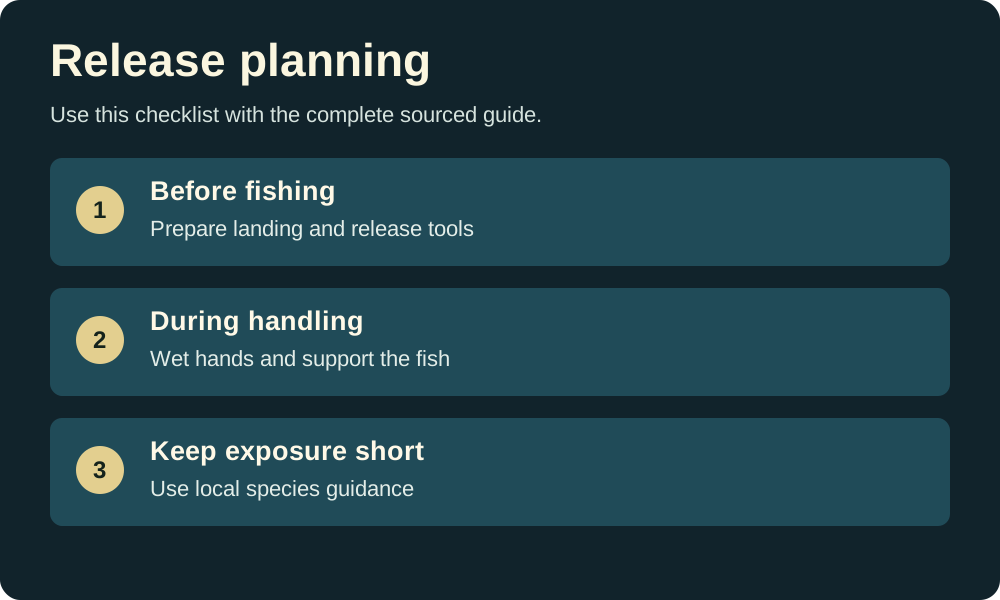
Prepare the landing and release equipment before fishing. Keep the fish in the water where practical, wet your hands, minimise air exposure and support the body horizontally. Use appropriate tools and follow local rules and species-specific guidance. Release promptly when it is ready. Careful handling reduces avoidable harm, but survival cannot be guaranteed.
Fish careShould I puncture the bulge coming from a deep-caught fish’s mouth?
No. A protruding stomach can be a sign of barotrauma, and NOAA explicitly warns against puncturing it or using a knife. Appropriate descending equipment can return affected fish to depth for recompression. Prepare the correct device and learn the relevant fishery procedure before fishing deep water. This is different from venting the swim bladder, which requires specific equipment and competent instruction; the visible stomach is not the target.
Food & water qualityCan I tell whether green water or surface scum is a toxic bloom?
You cannot determine toxicity by appearance alone. England’s official guidance advises treating a suspected algal bloom cautiously: avoid contact with the affected water and algae, keep children and pets away, and report it to the Environment Agency. Follow current venue restrictions and local authority advice. A photograph can help describe what you saw, but it cannot confirm that the water is safe for fishing, handling a catch or swimming.
Food & water qualityCan clear water or a healthy-looking fish tell me it is safe to eat?
No. Chemical contamination cannot be judged from the appearance or smell of either the water or the fish. Before keeping fish for food, check the current consumption advisory for that waterbody and species through the responsible health or environmental authority. Follow posted warnings too. The absence of a warning sign does not establish safety, and a legal harvest limit is not the same thing as consumption advice.
KnotsMy Palomar loop will not pass over the lure. Can I tighten it anyway?
No. Passing the attached hook or lure through the loop is part of the Palomar’s construction, not an optional finishing step. Start again with enough doubled line to make a workable loop, keeping exposed hooks controlled. Check that the loop clears the whole attachment before seating the knot. If the tackle makes this impractical, use another connection recommended for the actual line and attachment.
KnotsWhat knot can join braided main line to a fluorocarbon leader?
A double uni is one option for joining main line and leader. Check the exact line maker’s instructions for the materials and diameters, practise with cord, moisten, seat and carefully test the finished connection. Diameter differences and knot construction matter. FG and Alberto knots are other options, but this answer does not rank them without a suitable comparison.
KnotsWhy moisten a fishing knot before tightening it?
Moisture helps the knot draw into its intended shape and reduces friction heat as the line moves against itself. Oregon’s fisheries agency explains that this heat can weaken leader or tippet material. Tightening technique still counts: follow the instructions for that knot and line, inspect the finished connection and test it carefully. Wetting a badly assembled knot does not make it reliable.
LineCan I fill a spinning reel with any fluorocarbon leader material?
Do not assume a leader product is interchangeable with a mainline product. Seaguar describes its leaders and mainlines as different designs: leaders work over shorter lengths, while mainlines distribute impact over longer lengths. Check the exact product’s intended use and reel compatibility. A matching breaking-strength label does not establish that two products will handle or cast alike.
LineHow do monofilament, fluorocarbon and braid differ?
Nylon monofilament is a single strand with noticeable stretch. Fluorocarbon is another single-strand material used for leaders and, in suitable products, main line. Braid combines fibres and generally has relatively little stretch. Compare the exact product’s diameter, condition, casting behaviour and knot guidance rather than assuming a material is invisible or universally strongest.
LineWhy should I stop winding when a spinning reel’s drag is slipping?
If the handle keeps turning while line cannot be retrieved, the rotating pickup can add twist instead of recovering line. Lew’s identifies winding against a slipping drag as one cause of this problem. Stop cranking until you can recover line under control. If twist returns, also inspect how the line was spooled and whether the bait or lure rolls during retrieval.
PresentationHow should water clarity affect my lure-colour choice?
Start by making sure your lure reaches the intended area and moves as designed. In a safe, clear shallow area you can watch its action before casting. Try a visible contrast if you want to compare options, then change one variable at a time and record the result. No single colour is proven to trigger strikes in every water or weather condition.
PresentationShould a fly-line mend always go upstream?
No. For an intended dead drift, choose the direction that reduces unwanted pull on the fly. Orvis explains that faster water beneath the near line can require an upstream mend, while slower water between you and the flies can require a downstream mend. With an indicator, reposition the line without moving the indicator itself. The purpose of the presentation comes before a fixed mending rule.
PresentationWhen should I try a surface lure, a diving lure or a bottom rig?
Choose a presentation that you can control at the depth you intend to investigate. A surface lure works at or near the surface, while a diving lure travels below it during retrieval. A bottom rig places the weight near the bed, and a drop-shot positions its hook above the weight. Check the exact lure and local rules, then compare deliberately.
PresentationWhy are the fish not biting today, and what should I try?
Compare where and how you are fishing with yesterday. Check access, safety and whether your lure is reaching the intended depth. Change one observable variable, such as retrieve pace or casting angle, then record what happens. Temperature, food and shelter can differ between sessions, and a single catch or blank cannot establish the cause.
Rules & accessCan I fish during an English river close season if I release everything?
Catch and release does not override a prohibition on fishing for a species. England’s coarse-fishing river close season restricts fishing itself, rather than simply keeping the catch. Rules depend on the species, water and area; permitted game fishing can also have bait and lure restrictions. Read the current local byelaws and fishery conditions instead of assuming that returning every fish makes the session lawful.
Rules & accessDoes paying a private fishery day ticket replace my rod licence?
No. In the areas covered by the England and Wales rod-licence rules, fishing on private land does not remove the licence requirement. The fishery ticket grants the relevant permission to fish that venue; the rod licence is a separate requirement, subject to the official age and licence rules. Check both documents and the venue conditions before travelling. The Border Esk is included; the rest of Scotland and Northern Ireland have different arrangements.
Rules & accessWhere can I find the legal size and bag limits for my fishing spot?
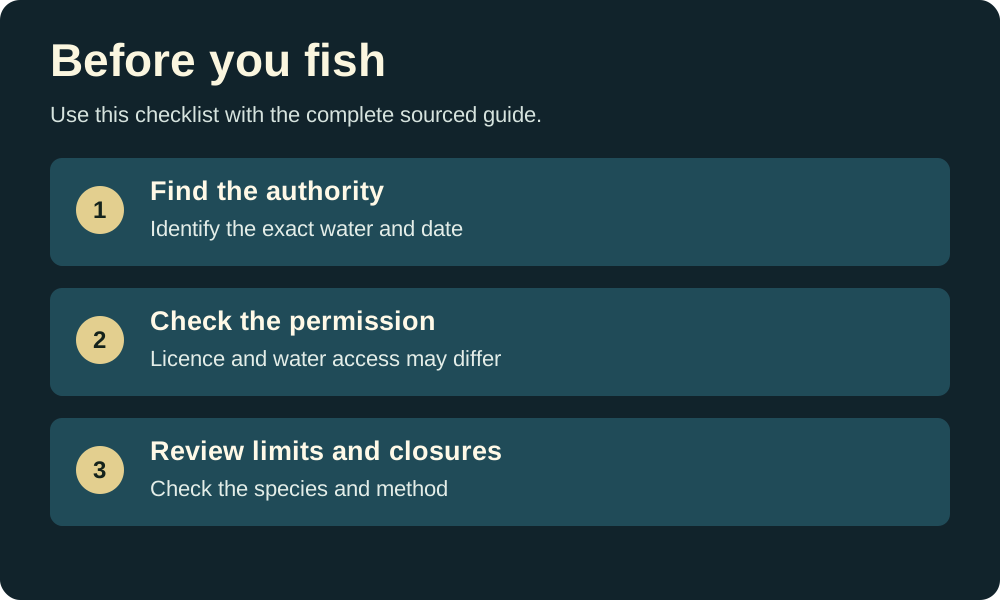
Identify the exact water, jurisdiction, date and species, then check the responsible state, national or local fishery authority and the water owner’s conditions. Verify licence and access separately from size, bag, possession and seasonal rules. Record the source and date. A limit from another water or an older trip may not apply.
Session recordsI caught a fish immediately after changing lures. Does that prove the new lure was better?
It establishes that the catch followed the change, but does not isolate its cause. Time, location, presentation or other conditions may also have changed. NIST’s experimental-design guidance explains why other influential factors need recording or control. In your journal, note the lure change and the surrounding conditions, then treat the result as a reason for another comparison rather than a universal verdict.
Session recordsShould I average the hourly catch rates from sessions of different lengths?
For this site’s session log, divide all recorded catches by all recorded active angler-hours. Do not give short and long sessions equal weight by averaging their rates. For example, six fish in two hours plus zero fish in one hour gives six divided by three: two fish per angler-hour. Keep the zero-catch session, and use matching definitions of catch and effort throughout.
TackleDoes a fast-action rod automatically have more power?
No. Action describes the part of the blank that bends under load; power describes the force needed to load it. A light-power rod can still have a fast action. Compare the stated casting range and intended use alongside both labels. Shimano also explains that power labels are not universal, so two rods marked medium-heavy are not automatically equivalent.
TackleWhat is the difference between a spinning reel and a baitcaster?
A spinning reel carries a fixed spool below the rod and releases line when the bail is opened. A baitcasting reel uses a rotating spool and needs spool control during a cast. A spinning outfit is a common starting point for learning, but choose the rod, reel and casting weight together and practise with a hookless weight.
TackleWhy can two reels with the same gear ratio retrieve different amounts of line?
The ratio counts rotor revolutions per handle turn on a spinning reel; it does not measure centimetres of line. Spool size also changes the amount recovered. Compare the exact model’s published line-retrieval figure, using the same units. A larger ratio alone is insufficient evidence that one reel will collect more slack per turn than another reel of a different size.
Weather & waterCan a cold front or barometric pressure predict when fish will bite?
Treat pressure and a weather change as observations to record, not a reliable bite forecast. Water temperature, location, species and presentation may also change. Check the current official forecast for safety, observe the water and compare sessions cautiously. A pressure reading alone cannot establish why a fish did or did not bite.
Weather & waterDoes a tide table include the effect of today’s wind and river flow?
Astronomical tide predictions do not include all the short-term changes caused by wind, atmospheric pressure or river flow. Actual water levels and currents can therefore differ from the table. Check the relevant official coastal forecast, warnings and observations as well as the tide prediction. For shore access, treat the table as one planning input, not a promise that a route will remain exposed until a particular minute.
Weather & waterDoes high tide mean the current stops?
Not reliably. High tide describes water level; slack water describes a period of very weak tidal current. Their timing depends on the location, and NOAA warns that the simple assumption that they coincide fails in many places. Use the current prediction for the actual inlet, channel or fishing area alongside the tide-height prediction. A nearby harbour’s high-water time is not a substitute for a local current forecast.
Weather & waterIf a river gauge reads two metres, is the river two metres deep?
No. Gauge height measures the water surface above that gauge’s reference level, which is not necessarily the riverbed. USGS explains that each gauge site has its own selected reference point. Use the station’s history and guidance to understand its readings; do not treat the number as a depth measurement or directly compare it with a different river’s gauge. It cannot establish that a crossing or wading route is safe.
Weather & waterIs a fishing umbrella or open shelter enough when I hear thunder?
No. The National Weather Service says that no outdoor place is safe during a thunderstorm. Stop fishing and reach a substantial enclosed building or an enclosed metal-topped vehicle with the windows closed. An umbrella does not meet that shelter guidance. Remain sheltered for at least 30 minutes after the last thunder. Plan a reachable shelter before the trip, rather than waiting for rain to start.
Water accessWhere can I fish Lake Fork from a public pier?
TPWD lists E4, the SRA Day Use Area near the Texas 154 bridge, as a free fishing pier. The F1 Highway 154 public ramp is a separate launch. Check the access map, site status and lake-specific rules before setting out.
Water accessDoes a Rutland trout bank ticket let me fish every bank?
The ticket covers the permitted activity and the fishery map sets out the banks and seasonal restrictions. Match your date and numbered stretch to the key. Check the national rod licence requirement separately.
RiggingWhy does a Carolina rig need a leader behind the weight?
The swivel stops the sliding weight on the main line. A separate leader connects the swivel to the hook, allowing the soft plastic to trail. On a conventional Texas rig, the weight sits next to the bait and the main line ties directly to the hook.
Weather & waterHow do I tell whether a river is higher than yesterday?
Compare gauge height at the same USGS station, in the same units, roughly 24 hours apart. Check the timestamps. The Conditions Notebook shows the difference when a matching observation is available; the full station graph shows changes that happened between the two readings.
Rules & accessDo I measure a Florida pompano to the tail tip or the fork?
Florida FWC specifies fork length for Florida pompano. Measure straight from the closed-mouth jaw or snout tip to the middle of the tail fork. Check the rule for your fishing area before deciding to keep the fish.
Fish populationsDoes a large fry stocking mean there are adult walleye to catch now?
The number records fish released at that life stage. It cannot establish their survival or present size. Check the stocking year and lake ID, then look for newer survey evidence on that same water.
CastingShould I tighten a Daiwa Zero Adjuster before my first cast?
Daiwa supplies its Zero Adjuster factory-set. On initial setup, use the magnetic cast-control dial to tune the cast. A conventional spool-tension knob has a different setup procedure, so identify the exact reel before changing it.
No answer matches these filters. Try a shorter term or clear the topic.
Visual checklists
Rules and access answers identify their region. Check current local requirements before a trip. These are source-checked explanations, not field-test claims.
Still have a question?
Join the moderated discussion or send a source-backed correction. Reader comments are separate from the checked answer database.