

In this guide
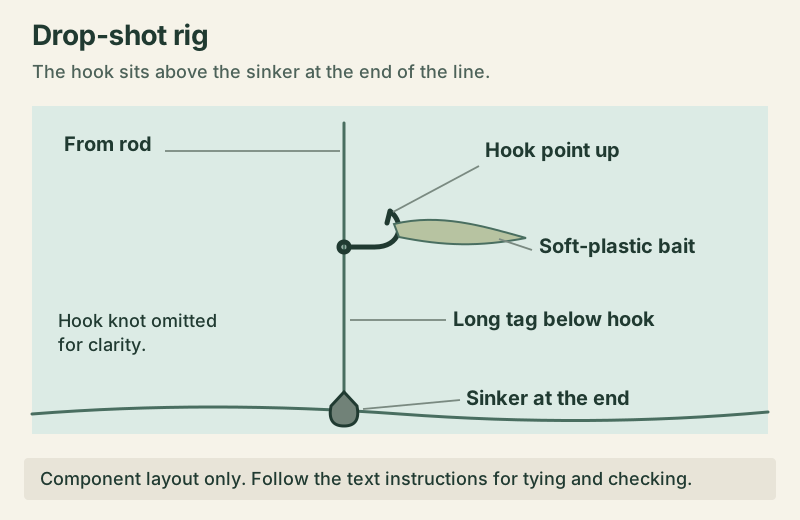
A drop-shot holds a hook partway along the terminal line, with the sinker hanging below it. This separates the lure from the weight and allows small movements of the bait near the bottom. It is a useful next step after a simple float or basic lure rig.
Suitable conditions and limitations
Choose clear bottom access with limited snagging cover while learning. A bank cast places the line at an angle, so the hook’s distance along the line above the weight is not automatically its vertical height above the bed. Strong current and dense weed make that relationship less predictable.
Gather the parts
Use matched spinning tackle, compatible mono or fluorocarbon terminal line, a drop-shot hook, a small soft-plastic bait and a purpose-made weight. Keep the complete casting load inside the rod’s rating. An exposed nose-hook is straightforward but can catch vegetation.
Build the rig
- Tie the hook using a Palomar, leaving a long tag below it instead of trimming the tag away.
- Check the hook hangs with the point up. If needed for the chosen hook and knot, pass the tag back down through the eye from the point side to orient it correctly.
- Attach the sinker to the tag below the hook. Start with roughly a foot of separation, then adjust for the water and line angle.
- Follow the weight’s design: a pinch clip grips the tag differently from an ordinary eye that requires a knot.
- Nose-hook the plastic lightly so it hangs straight and can move. Do not bunch the bait around the hook gap.
- Lower the setup into view before casting. Confirm the hook, bait and sinker sit in the intended order.
Work it quietly
Let the weight settle, remove loose line and make small rod-tip movements. Pause. You are trying to move the lure without hauling the weight across the bed on every movement. Reposition occasionally, then repeat the same controlled presentation.
Troubleshooting
If the hook folds downward, inspect its orientation and the line route through the eye. If the plastic spins or bends, remount it straight. If you keep catching weed, shorten the test cast, change the position or use a more suitable rig rather than adding weight indefinitely.
Next useful adjustment
Compare one change at a time: bait size, time between movements or hook-to-weight separation. Record what happened without treating one catch as proof of a universal rule. Hook orientation and any diagram of the eye crossing need practical review before publication.
Questions from the bank
Keep it helpful. Comments are moderated. Do not share precise locations or personal information.
No approved comments yet. Ask a practical question or share what you learned.