

In this guide
Read power, action, lure rating and line rating as separate pieces of information. A rod described as fast is not automatically powerful, and a heavier power label does not by itself tell you which lure it will cast well. Start with the rig you need to present and the space in which you will use it.
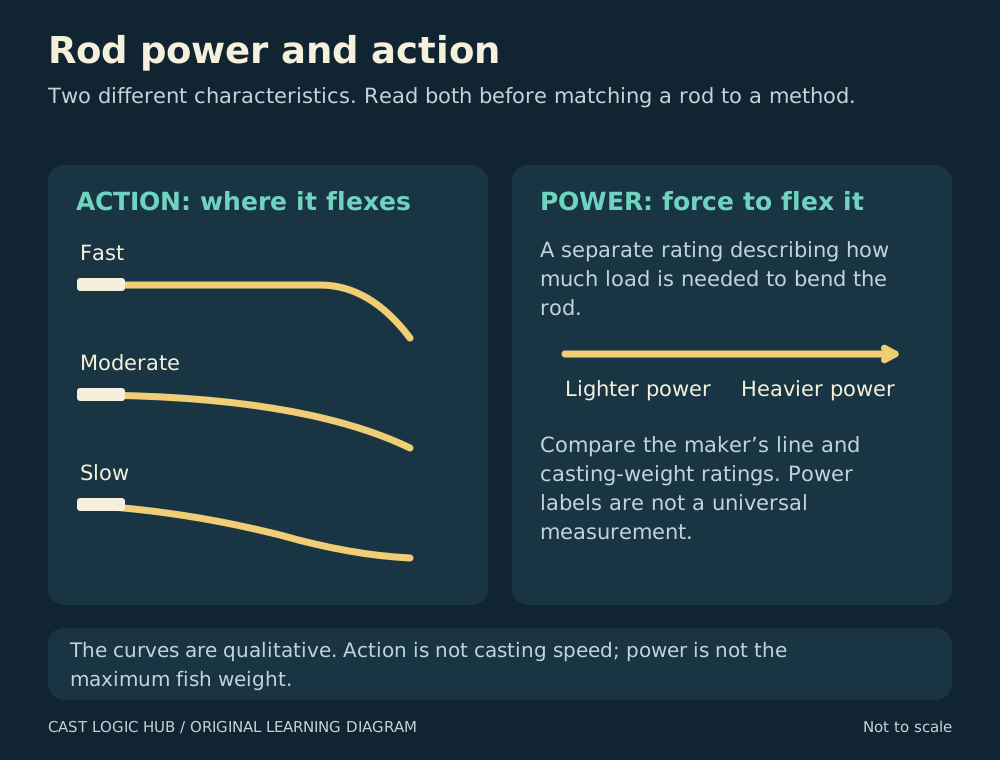
Power and action answer different questions
St. Croix defines power by the pressure needed to flex the blank. Action describes where the rod flexes: faster actions bend mainly nearer the tip, while slower actions involve more of the blank. These labels describe behaviour; compare each maker’s actual ranges rather than assuming that two rods labelled “medium” will suit identical loads.
A specification table may list medium power and fast action together. That is not contradictory. It says something about resistance and something different about the distribution of flex. Read both, then check the lure and line ranges for the exact model number.
| Specification | Question it helps answer | Do not assume |
|---|---|---|
| Power | How much resistance does the design offer? | Equal words mean equal behaviour across brands |
| Action | Where does the rod flex? | Fast means a faster retrieve |
| Lure rating | What casting load is the model intended for? | The head weight is the entire rig weight |
| Line rating | What line range does the maker specify? | It is a safe lifting weight for a fish |
| Length and handle | Will the rod fit the casting space and user? | Longer is always better |
Calculate the casting load you will actually use
Put the complete terminal setup on a suitable scale. Include the lure body, jighead or sinker, hook and other components that travel with the cast. With bait or a loaded feeder, allow for what is added when fishing. A printed sinker weight is only one component.
As an arithmetic example, a 7 g head plus a 5 g plastic and 1 g of other terminal tackle creates a 13 g casting load. These are invented example values, not a recommended rig. Compare your measured load with the manufacturer’s range, leaving room for changes rather than planning every cast at an uncertain limit.
Compare exact models
St. Croix’s Avid table lists length, power, action, line and lure ratings separately, and different models within one family have different combinations. This is why the family name alone is insufficient. Check spinning versus casting construction, number of sections and the model code before ordering.
Record three candidate rods in a small table using the same units. Convert ounces and grams if necessary, but keep the original manufacturer figures alongside the conversion. Do not convert a vague power description into an invented lure range.
Make a task-based choice
- List the two or three rigs you expect to use most, with their complete casting loads.
- Describe the water and cover, the target fish and how you will land them.
- Choose a length that fits your bank, boat or kayak position and casting clearance.
- Compare the maker’s exact model specifications and technique guidance.
- Handle the outfit with the intended reel when possible. Check grip comfort and control, rather than judging the rod from a tip wiggle alone.
- Start with controlled casts in the recommended range and assess placement and presentation.
Keep the outfit balanced as a system
Line, hook, drag and rod work together. A powerful blank does not excuse a damaged connection, and stronger braid does not increase the rod’s safe casting load. Read the reel’s specifications and the line maker’s guidance rather than using the largest number printed anywhere on the outfit.
When a rig casts poorly, first verify its weight and assembly. Inspect line condition and guide alignment. A new rod cannot correct an overfilled spinning spool or a lure attached in a way that makes it tumble.
Recognise the limits of a label
Published ratings are a starting point, not a laboratory test performed by this site. No stiffness, recovery speed or durability comparison is claimed here. For a meaningful purchase comparison, keep manufacturer facts separate from your own observations and from another angler’s personal preference.
Questions from the bank
Keep it helpful. Comments are moderated. Do not share precise locations or personal information.
No approved comments yet. Ask a practical question or share what you learned.