
In this guide
Use a journal to make the next decision more informed, not to turn a few catches into a universal rule. Record effort and unsuccessful sessions alongside catches. A method that produced more fish after many more hours may not have performed better on a comparable basis.
Define the record before collecting it
For this journal, use one entry for a session or a clearly defined method segment. Record date, general water, intended species, method, bait or lure, active fishing time, anglers included, catches and important observations. Keep landed fish, missed bites and fish lost before landing in separate fields or notes rather than adding them together.
Define active time consistently. For example, count time spent fishing and exclude travel and meal breaks. If two people fish for two hours and catches include both people, the matching effort is four angler-hours. Do not divide a group’s catches by one person’s time.
Calculate a rate with explicit units
Count-based catch rate = total recorded fish caught ÷ total active angler-hours. This is the site’s chosen journal convention. Fisheries programmes use different effort and catch units: NOAA’s WPacFIN tool, for example, reports weight per effort unit with gear-specific definitions. Do not compare differently defined rates as if they were the same measure.
For a hypothetical example, one session produces three fish in one hour and another produces one fish in three hours. The combined rate is four fish divided by four hours, or one fish per hour. Averaging the two session rates would give a different and misleading answer because the durations differ.
A no-catch session with valid effort belongs in the calculation. An entry with unknown or zero effort cannot produce a meaningful hourly rate. Keep it as a note or exclude it from that calculation with a visible explanation; do not replace missing time with an invented estimate.
Inspect the data before comparing
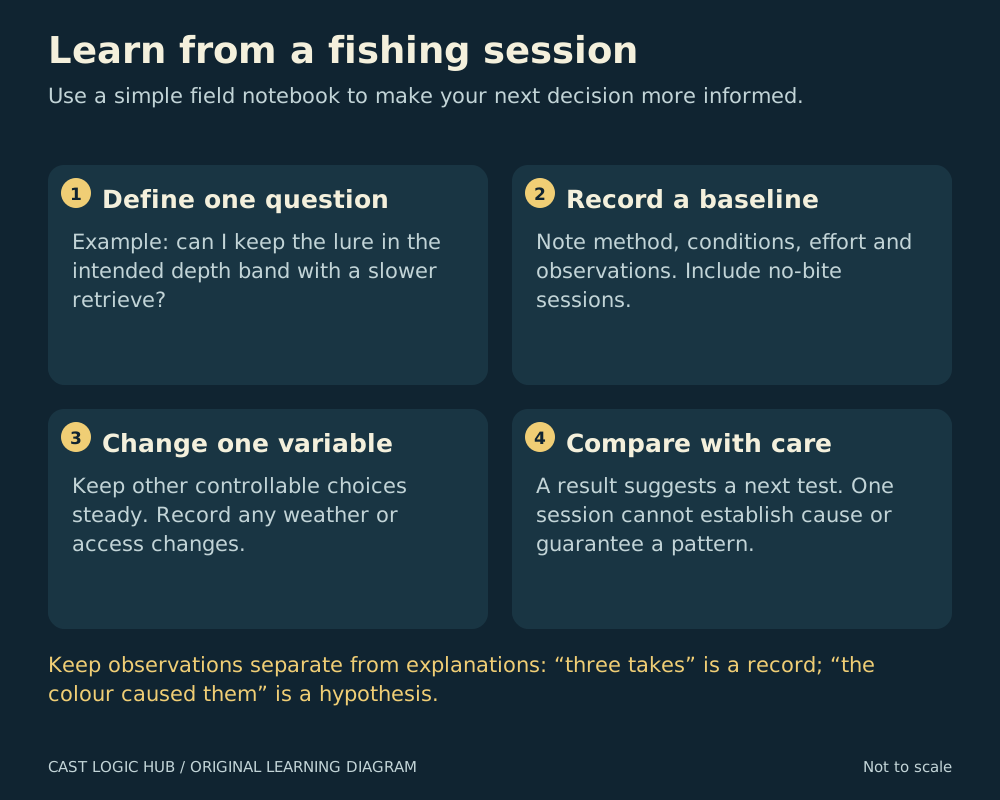
- Choose one question, such as whether you maintained useful depth control with two jig weights.
- Filter to genuinely comparable sessions or segments: the same broad water context, target and method.
- Check for duplicate entries, mixed units and missing effort.
- Show the number of sessions, total catches, total effort and the calculated rate together.
- Read the notes for differences in access, weather, presentation or angler participation.
- Write a cautious next test rather than declaring a permanent winner.
NOAA’s recreational-fishing methods distinguish catch rate from total effort and use a designed sampling system to estimate population-wide catch. A personal journal is not that survey. Its totals describe the recorded activity and may not represent the whole water, season or angling population.
Separate observations from explanations
| Entry | What it establishes | What it does not establish |
|---|---|---|
| More fish on method A during logged sessions | A difference in these records. | That method A caused the difference. |
| Higher catch rate in one depth range | A pattern in the sampled effort. | That the range will be best next time. |
| No catches in two visits | No recorded catches during that effort. | That fish are absent. |
| Fish caught after a lure change | The catch followed the change. | That colour rather than time or position caused it. |
Improve the next comparison
NIST’s experimental-design guidance describes randomisation and blocking to reduce confusion from other factors. Applied cautiously to an angler’s practice, that means choosing the comparison in advance, giving options comparable opportunities and recording conditions that can affect the result. It does not turn an informal fishing trial into a controlled scientific experiment.
For a practical exercise, compare two presentations during short, planned periods in the same permitted area, and vary which one is used first across visits. Keep other equipment choices consistent where appropriate. Stop the exercise whenever fish welfare, weather or access requires it; completing a comparison is never more important than those decisions.
Make the result useful
Finish each review with one sentence describing the evidence and one describing the next action. For example: “I lost bottom contact more often on the lighter setup during these two drifts; next time I will repeat the comparison in similar conditions and record line angle.” That is useful even when neither setup caught a fish.
Back up the journal and keep sensitive locations private. The value comes from honest, repeatable observations, including inconvenient blanks and failed assumptions, rather than from a high-looking catch rate.
Questions from the bank
Keep it helpful. Comments are moderated. Do not share precise locations or personal information.
No approved comments yet. Ask a practical question or share what you learned.