

In this guide
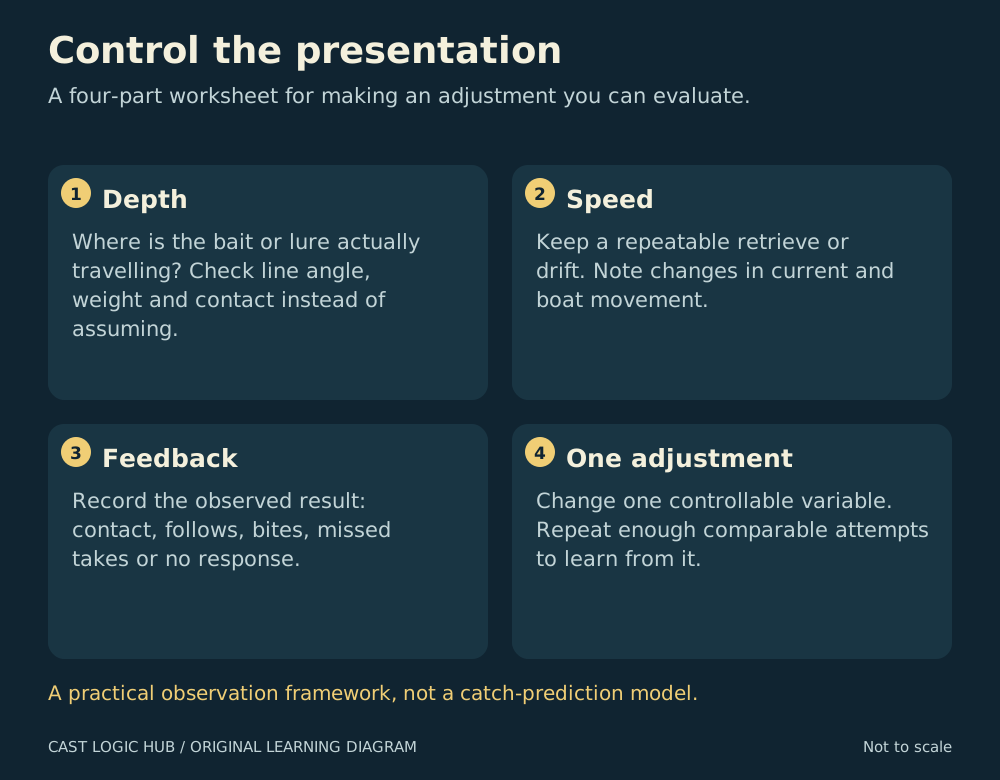
A productive jigging session starts with knowing roughly where the lure is and what part of its movement you can control. Repeated rod lifts mean little if current carries the jig beyond the intended area or if uncontrolled slack hides its fall. Establish a repeatable presentation before experimenting with colours.
Choose the job first
Vertical jigging works beneath or close to your position. Cast jigging brings a lure back through a wider area. RBFF describes both methods, while Minnesota DNR’s walleye guidance recommends enough weight to maintain useful contact without making the jig unnecessarily heavy.
The bottom is one reference point, not the only place a jig can be fished. A suspended target requires a different plan from a lure being worked over clean bottom. Do not repeatedly drop below fish or drag through vegetation merely because the technique is called jigging.
| Presentation | Useful control | Common loss of control |
|---|---|---|
| Near vertical | Short, direct line path | Boat or current moving faster than the lure |
| Cast and retrieve | Deliberate sink and retrieve stages | Large line bow obscuring the fall |
| Above bottom | A repeatable depth reference | Assuming every stopped fall means bottom |
Check the rig where you can see it
Rig a soft plastic straight and inspect the hook. Lower it in clear water and observe its fall with gentle line control. A crooked body can behave differently from the intended profile. Try a short lift and pause, then notice how much lure movement a modest rod action creates.
Choose weight within the complete outfit’s ratings. Increased depth and water movement may require a different head, but there is no universal grams-per-metre rule. Body shape, line, drift and cast length all change the practical result. If the setup remains hard to control, changing position or presentation can be better than continuously increasing weight.
Build a repeatable cast presentation
- Choose a clear lane and a safe direction. Make a measured cast and note where it lands.
- Follow the fall with enough line control to observe an unexpected stop or movement. Do not force every lure to fall on a tight pendulum.
- Where bottom contact is intended and appropriate, identify it cautiously from several cues. A stopped line can also mean vegetation or a fish.
- Move the lure with a short lift or controlled retrieve. Recover excess line as you reset the rod.
- Repeat the same action across that lane. On the next cast change only one feature, such as pause length or lift height.
Use the rod movement the fish can tolerate
More movement is not automatically more attractive. Minnesota DNR’s crappie guidance distinguishes movements intended to attract attention from subtler movements near an interested fish. Treat that as a reason to test stroke size, not as a guarantee that every species responds identically.
A useful exercise is three short passes with an unchanged lure: one with gentle lifts, one mostly retrieved, and one with longer pauses. Record control, contact with cover and observed fish responses separately. The exercise is an editorial comparison plan, not a scientifically validated catch-rate test.
Diagnose what the line is telling you
If the lure continually drags behind a drifting boat, shorten the pass or improve boat positioning before adding more line. If the lure repeatedly collects plants, raise the working depth or choose a different path. If contact disappears after a wind shift, reassess the line bow and drift rather than deciding the fish have stopped feeding.
A slow, heavy feeling may be vegetation; a distinct tap may be bottom; either may also be a fish. There is no single signal that proves the cause. Stay ready to respond, inspect the lure after each suspicious retrieve and compare the event with your previous casts.
Finish with a useful record
Record the head weight, lure body, line, approximate depth, cast direction and movement that remained controllable. Mark depth estimates as estimates. Keep a separate note of actual catches and uncertain contacts. Your next session then starts with a repeatable method instead of a remembered colour alone.
Questions from the bank
Keep it helpful. Comments are moderated. Do not share precise locations or personal information.
No approved comments yet. Ask a practical question or share what you learned.