In this guide
On a river, choose the path your lure should travel before you choose its colour. Current can move the lure, line and surface at different rates. A promising cast is one that reaches a useful lane at a manageable depth while leaving you able to recognise contact and recover the tackle.
Read the water from a safe position
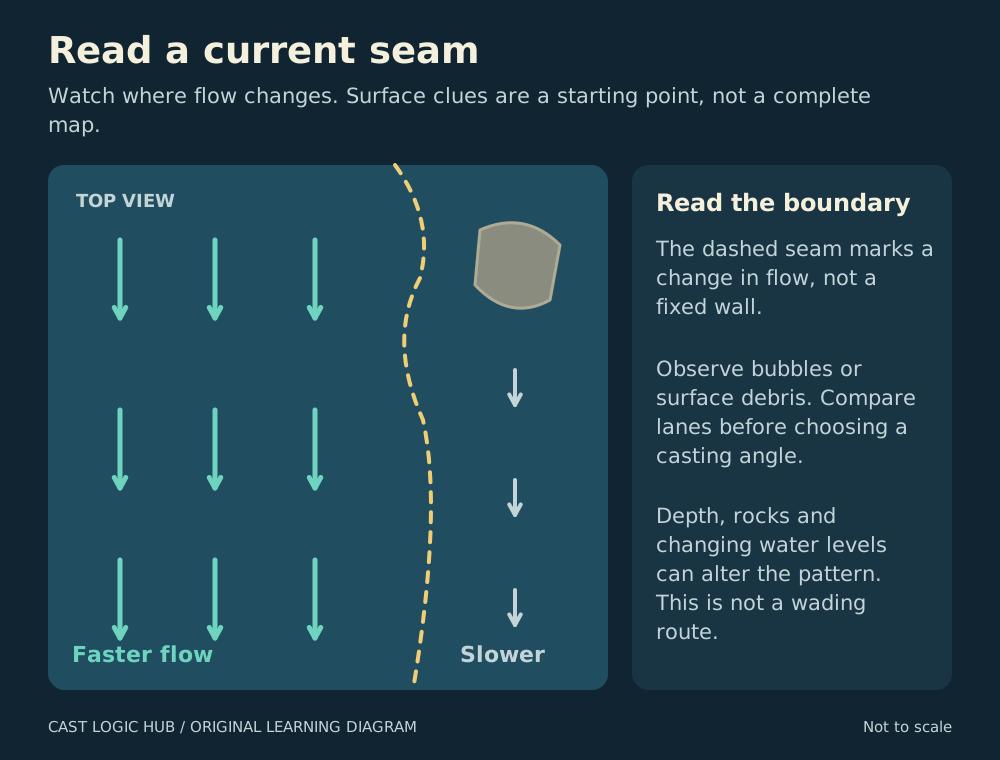
Look for changes rather than one supposedly perfect feature. Riffles, runs, pools and eddies divide a reach into different kinds of water. Missouri’s trout guidance describes runs as flowing sections, pools as deeper holding areas and eddies as slower pockets associated with obstructions.
Current breaks and nearby cover offer useful starting points. RBFF highlights calmer water below islands and rocks, vegetation and places where flows meet. These features suggest where to investigate; they do not prove that a fish is present or that the bank is safe to approach.
| Visible feature | Question to ask | First observation |
|---|---|---|
| Fast water beside slower water | Can the lure travel along the boundary? | Watch naturally drifting material |
| Pool head or tail | Where does flow concentrate? | Compare the entry and exit lanes |
| Rock or island | Where is the calmer pocket? | Observe both sides without entering the water |
| Overhanging cover | Is there a clear casting and landing route? | Check branches, footing and access |
Plan the presentation as three stages
Write down a landing point, a fishing lane and an exit. The landing point may need to be upstream of the useful lane to allow the lure to sink. The fishing lane is the part you want to investigate. The exit is where you retrieve before the lure reaches an obstruction or creates a line-control problem.
This three-stage plan is an editorial exercise. It prevents every cast from becoming an attempt to rescue a lure after it has already drifted past the target. Begin with a short, visible path, then extend distance only when you can explain what changed.
Make a controlled first pass
- Watch the flow before casting. Note where surface material speeds up, slows or circles.
- Choose a legal, stable bank position and an unobstructed delivery. This lesson does not require wading.
- Cast to the planned landing point, allowing the lure time to reach the chosen lane.
- Recover surplus line or reposition the rod as needed to manage the bow. Avoid abruptly dragging the lure out of the lane merely to make the line look straight.
- Retrieve at the planned exit. Inspect the lure for weed, damaged line or a displaced bait before repeating.
Change angle before blaming the lure
Two casts with the same tackle can fish differently when their angle to the current changes. A longer line path exposes more line to the flow. Before adding weight, test a shorter cast or a legal bank position that makes the lane easier to reach. Then adjust weight only within the rod’s complete casting-load rating.
Distinguish a deliberate swing from an intended drift. A swing allows tension and current to bring the lure across the flow; a drift aims for a different travel path. Neither is automatically correct. Choose the path for the presentation you are testing and judge whether the tackle actually follows it.
Keep species and river state in the decision
Trout, bass and other fish do not use every feature identically. RBFF’s fly-fishing guidance links trout feeding positions to food delivered by flow and resting positions to protection. Use that relationship as a hypothesis, then look for local evidence. Do not assume every calm pocket holds a fish.
Reassess after a change in water level, clarity or flow. A useful lane from an earlier visit may have shifted. Rising or unstable water is a reason to reconsider access, not an invitation to stand closer for a better cast. Remain outside hazardous edges, weirs and restricted areas.
Record a lane you can find again
Use a general feature description rather than publishing a sensitive location. Record the bank position, flow direction, landing point, approximate sink period and exit. Note whether the lure reached its lane cleanly. That information is more useful next time than “river fishing was slow”.
Questions from the bank
Keep it helpful. Comments are moderated. Do not share precise locations or personal information.
No approved comments yet. Ask a practical question or share what you learned.