

In this guide
Depth setting decides where the hook can reach. Shot placement influences how the rig settles and how an alteration near the hook becomes visible at the float. Treat those as separate controls. A well-balanced float can still be fishing the wrong depth, and a correctly measured depth can still produce poor presentation.
Find a repeatable depth reference
Start with a sound rig and a plummet appropriate to the tackle and bottom. Lower or cast it onto the exact line you intend to fish. On a pole, keep the line as vertical as practical while you compare points; a different pole position can turn an apparent depth change into a measurement error.
- Inspect the float attachment, line, shot and hook before measuring.
- Sample the intended position, then neighbouring points closer, farther, left and right. Note whether the bottom appears level or sloping.
- Adjust the float until you have a consistent reference for the hook reaching the bottom. Follow the plummet’s attachment method; different arrangements do not put the measuring point in precisely the same place.
- Record that setting on your rig board or with a removable reference on the pole’s top kit.
- Remove the plummet, add the intended hookbait and check the float’s working position again. The fishing rig must be assessed without the measuring weight attached.
The reference is a baseline, not a compulsory fishing depth. It lets you deliberately fish above the bed, at it or with some line laid on it, and return to the original setting after an experiment.
Choose what the shot should do
| Arrangement | Purpose | Trade-off to watch |
|---|---|---|
| More widely spread shot | Explore a slower final descent | More settling stages to read and control |
| Main bulk with smaller droppers | Deliver most weight together while retaining a controlled final section | Droppers and hooklength must suit the intended presentation |
| Two compact bulks | Make a positive bottom-layer presentation and visible lift indications | Less subtle descent than a widely spread arrangement |
Drennan’s double-bulk explanation uses a larger upper group and a smaller group nearer the hooklength. Its exact dimensions are one application, not a template for every float, bait and depth. The useful principle is to decide how movement of the lower group should change the visible float.
Learn the settling pattern
Make several presentations in clear, accessible water if possible. Watch when the float first stands, when it sinks farther, and where it finally rests. Then repeat with your normal bait. This creates a visual reference for that rig; you can compare a suspicious interruption with something you have actually observed.
If the float stops settling early, the bait may have been intercepted, but it may also have caught vegetation or a shallower part of the bed. Check the next presentation and the retrieved hookbait. A single unusual movement does not identify the cause.
Adjust one control at a time
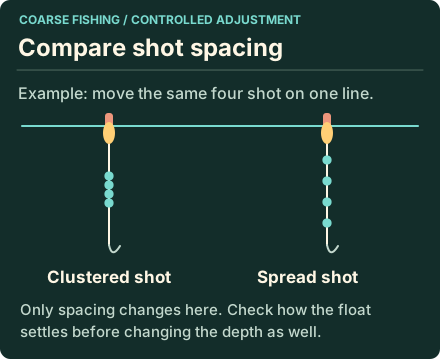
When the rig drags along the bottom, first check whether your measurement and casting position are consistent. If wind is pulling the line between pole tip and float, review that exposed line and pole position. Adding shot without understanding the cause may simply bury more tackle in the bottom.
When you want to test a different descent, leave the depth reference unchanged and alter the shot arrangement cautiously. When you want to explore a different feeding layer, keep the shotting stable and change depth. Inspect fine line after moving shot; visibly marked or damaged sections should be replaced.
Current needs a distinct test
A river float is influenced by flow and by the angler’s control of the line. Martin Bowler’s trotting account describes choosing between a chain of larger shot and an olivette bulk according to presentation and tangling problems in confined swims. It supports the decision principle, not a universal placement fraction for every river.
A practical record
Draw the rig on paper and record float model, actual loading, depth reference, shot positions and hookbait. For each change, add one sentence explaining the aim: “slower final fall,” “less dragging,” or “clearer lift indication.” Keep the most repeatable arrangement as your baseline.
Do not confuse complexity with sensitivity. The arrangement earns its place only when it delivers the bait as intended and gives you an indication you can interpret.
Questions from the bank
Keep it helpful. Comments are moderated. Do not share precise locations or personal information.
No approved comments yet. Ask a practical question or share what you learned.