

In this guide
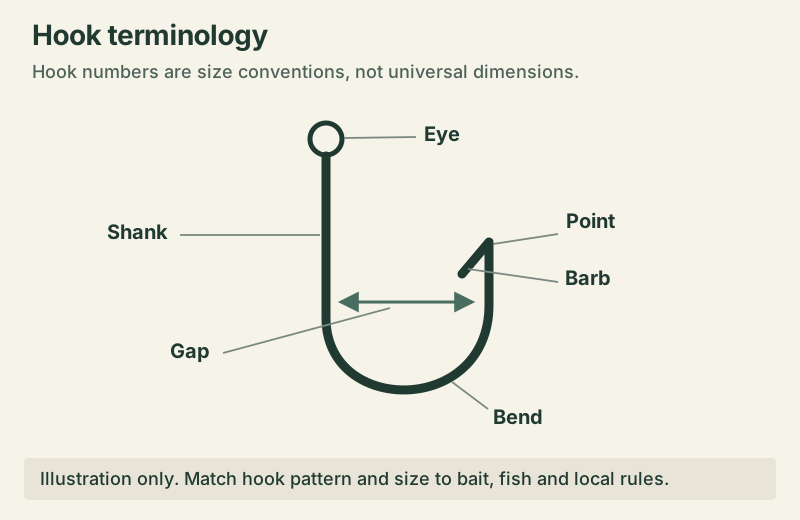
A hook should suit the bait, the intended fish and the way you will fish it. Choosing by a number alone misses much of the picture. Two hooks can carry the same size label while having different shank lengths, gaps and wire thicknesses.
Start by checking any venue restrictions on hook type, number of points and barbs. Then choose a pattern you can bait, remove and handle confidently. A small selection of suitable single hooks is usually easier to learn with than an unlabelled assortment.
Read the numbering
Within the conventional numbered range, larger numbers usually mean smaller hooks: a size 10 is smaller than a size 6 in the same pattern. In the /0 range, the direction reverses: a 4/0 is larger than a 1/0 in the same pattern. Say 1/0 as “one aught” in common US usage.
These labels are not millimetre measurements. Compare the actual hook or the manufacturer’s dimensional drawing, particularly when changing brands or patterns. Do not use a universal hook chart as a guarantee that one maker’s size fits like another’s.
Know the parts
- Eye: where a conventional eyed hook connects to the line.
- Shank: the straight or gently curved length below the eye.
- Bend: the curve leading toward the point.
- Gap or gape: the space between point and shank.
- Point and barb: the penetrating tip and, where fitted, the small projection behind it.
Wire thickness affects the hook’s bulk and strength, but “fine wire” is not a licence to pull harder. Match tackle pressure to the hook and expected fish. Replace a bent, corroded or damaged hook rather than assuming it can be safely straightened and reused.
Match the bait without masking the point
Lay the intended bait beside the hook before fitting it. The bait should be secure while leaving room for the hook to take hold. A large wad that fills the gap can prevent a good connection even when fish take the bait.
For a small worm piece intended for panfish, begin with a small single bait hook suited to that piece. The precise size depends on the pattern, bait and local fish. If you repeatedly lose bait without connecting, inspect the presentation and bait size before blaming the fish.
Circle hooks use a different response
A circle hook has a point turned inward and is designed to work as pressure builds and the hook moves toward the mouth’s edge. With an appropriate circle-hook setup, tighten steadily rather than making the sharp strike often used with conventional J hooks. Learn the particular technique before changing patterns during a trip.
Barbless hooks or properly flattened barbs can ease removal, but still require controlled line tension. Neither a barbless nor a circle hook eliminates the need to watch the rod, respond promptly and handle the catch carefully.
Questions from the bank
Keep it helpful. Comments are moderated. Do not share precise locations or personal information.
No approved comments yet. Ask a practical question or share what you learned.