
In this guide
Trolling covers water with a lure trailing behind a moving craft. To learn from it, you need a controllable route, suitable lure action and a realistic idea of running depth. A line counter or GPS reading is useful, but neither alone tells you exactly what the lure is doing.
Settle permission and boat operation first
Confirm the rules for your exact water, including allowed craft, propulsion, lines, hooks and tackle materials. The National Park Service stresses that watercraft and motor restrictions vary between parks. Do not transfer one place’s definition of trolling or line allowance to another.
Decide who is controlling the craft while a rod is being handled. Keep lines away from propellers and other traffic, have a landing plan and wear the appropriate flotation equipment. A fishing plan never replaces the navigation and operating instructions for the craft. Begin with a simple arrangement you can manage without abandoning lookout.
Choose a depth-control approach
| Approach | What it provides | What still needs checking |
|---|---|---|
| Lure directly behind the boat | A relatively simple starting arrangement | Lure-specific action and depth range |
| Added weight or diving device | Another means of reaching depth | The device’s own instructions and test conditions |
| Downrigger | A weighted cable and release system separate from the lure | Release setting, clearance and safe operation |
A downrigger’s displayed cable length is not an independent measurement of lure depth. Likewise, a diver’s model name is not a promise that every combination will reach its labelled depth. Luhr-Jensen identifies line length, line diameter and water speed among the variables affecting its Jet Diver.
Read a depth chart properly
Rapala describes its published lure depths as ranges under suitable conditions and notes the effect of line and speed. Match the exact lure size, not merely the family name. Record the line diameter and rig arrangement alongside any chart estimate. If the manufacturer’s conditions are missing, retain the figure as a rough planning aid.
GPS reports movement over the ground. The lure responds to movement through the surrounding water, so a displayed boat speed cannot by itself prove that lure action is unchanged between opposite-direction passes. Watch the lure near the craft when it is safe to do so, then choose a controlled speed that produces the intended action.
Run one clear comparison
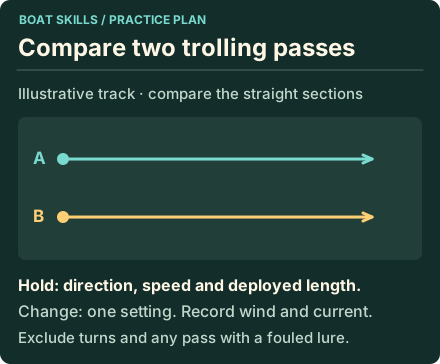
Open full-size graphic · National Park Service trolling guide
- Select a route with known clearance and enough room to turn. Review the map and actual depth information available.
- Check the lure, hooks, connection and rod holder. Confirm that the lure runs as intended beside the boat before deploying it.
- Let line out in a controlled manner and record the amount using the same reference each time.
- Follow a steady track and note depth, direction, observed conditions and lure behaviour.
- After the pass, inspect for vegetation or debris. An apparently unsuccessful pass with a fouled lure is not a valid comparison of lure choice.
- Change one variable for the next pass. Keep a note of which factors could not be held constant.
Account for turns
A turn changes the paths of lines trailing behind the craft. Avoid tight manoeuvres with an unfamiliar spread and retrieve tackle before a turn that cannot be made cleanly. When a bite occurs during a turn, record it accurately, but do not automatically attribute it to colour or a precise speed. Several things changed together.
Do not seek deliberate bottom collisions to calibrate a setup in sensitive habitat, unknown obstacles or places where tackle recovery would be unsafe. Manufacturer data, sound navigation information and a cautious test area are preferable to sacrificing lures to obtain a false sense of precision.
Keep the pass useful even without a catch
Log route, lure model and size, line, line out, speed source, direction, estimated running depth and elapsed fishing time. Separate “no fish caught” from “lure fouled” or “pass interrupted”. A repeatable clean pass gives you something to compare; a large number of unrecorded miles does not.
Mark interrupted passes clearly so they are not later counted as equal fishing effort.
Questions from the bank
Keep it helpful. Comments are moderated. Do not share precise locations or personal information.
No approved comments yet. Ask a practical question or share what you learned.