

In this guide
A feeder session becomes easier to understand when you control three things separately: where the feeder lands, when its contents leave, and how the hookbait behaves. Changing all three after every quiet cast hides the useful evidence. This tutorial builds a repeatable approach for permitted coarse fisheries, with changes based on what you retrieve and observe.
Choose the delivery job
| Job | Starting option | What to check |
|---|---|---|
| Deliver groundbait quickly | Cage feeder | Whether the mix survives the cast but opens as intended |
| Contain live maggots during delivery | Block-end feeder | Release rate and whether the bait remains lively |
| Keep a compact feed parcel near the hookbait | Appropriate method or pellet feeder | Maker’s rig instructions, bait preparation and safe release |
| Reduce free feed while retaining the chosen spot | Smaller feeder or suitable plain lead | Whether bites change when feed input falls |
These are starting options rather than a ranking. A feeder which works on a shallow commercial lake may empty too early in deeper water or behave poorly in strong current. Check the fishery’s rules before choosing the arrangement.
Build a casting reference
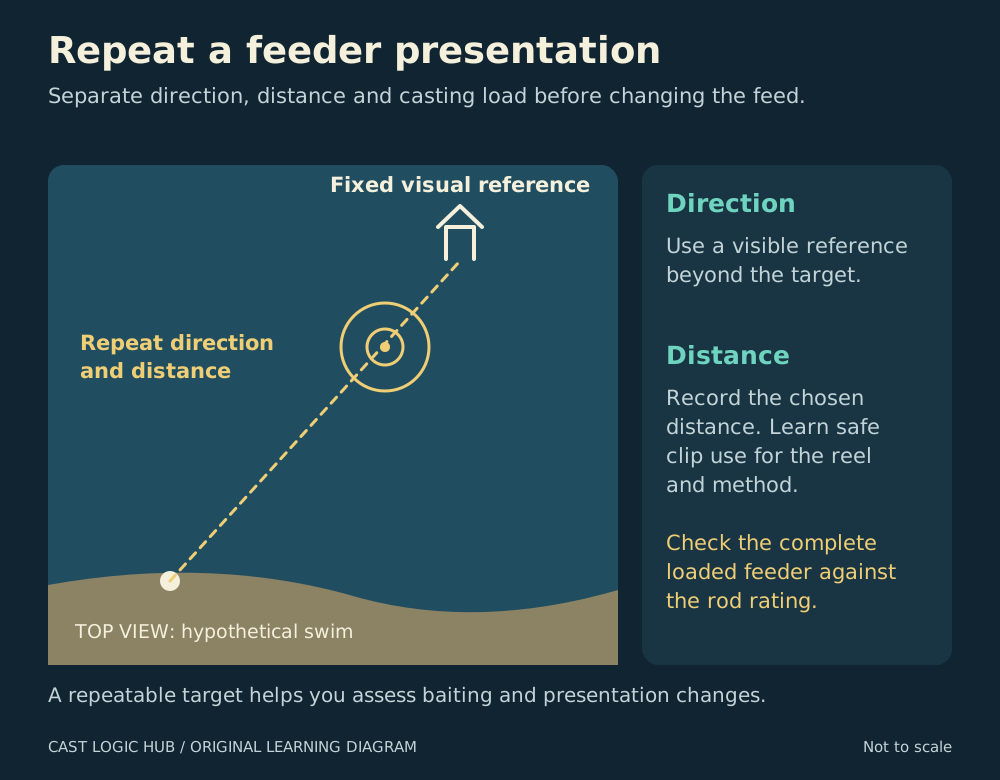
- Choose a clear casting lane and a visible direction marker. Pick a distance you can reach comfortably rather than repeatedly forcing the cast.
- Use the complete loaded feeder, not its empty stamped weight, when checking the rod’s casting range. Assemble the rig according to the component manufacturer’s directions.
- Make exploratory casts and select a manageable landing area. Record the direction and distance reference before feeding heavily.
- A reel line clip can help repeat distance, but a hard stop can create trouble when a powerful fish takes line. Use a marked-distance approach or a suitable release arrangement when continued line restriction would be unsafe for the setup.
- Keep the casting action consistent. Note whether a miss is left or right, short or long. Correct that error before changing bait.
A quiver-tip label is not a substitute for the rod’s casting specification. For example, Drennan lists supplied tips and the maximum casting weight separately. Look up both for the actual model; do not convert an ounce marking on a tip into permission to cast that mass.
Test the mix before blaming the fish
Prepare a small batch and test a loaded feeder in accessible water where you can see it. You are checking whether the parcel stays together during delivery and then releases; a bucket test cannot reproduce every depth, current or impact. Write down the preparation and adjust only a small batch so the rest remains available for a different mix.
Jon Arthur’s mini-feeder account shows the value of keeping pellets and groundbait separate before combining them. The general lesson is useful beyond that particular setup: preserve the ability to alter the ratio and moisture, and do not treat one angler’s exact recipe or recasting interval as a universal rule.
Read the whole indication
A pull on the tip and a sudden slackening of the line can require different responses. Watch both the tip and the line. A small knock may be contact with the line, and a missing hookbait can provide information which the tip movement alone did not reveal. Do not label every touch a missed feeding bite.
Use the hook and rig maker’s guidance for the appropriate response. In a self-hooking arrangement, an exaggerated strike can be unnecessary. Keep your response controlled and establish contact before applying pressure.
Diagnose a quiet spell
| Observation | Next check |
|---|---|
| Mix still packed into the feeder | Repeat the release test and adjust preparation before increasing feed |
| Rig regularly tangled | Inspect the retrieved rig; review casting control and the intended anti-tangle arrangement |
| Feeder repeatedly moves after settling | Review holding ability, slope and line tension before interpreting every movement as a bite |
| Fish respond, then indications fade | Log elapsed time, bait input and presentation; test reduced feed before assuming more is needed |
Use a short comparison session
For your next practice, keep the hookbait, casting target and rig constant while comparing two sensible feed-release preparations. Record casts, approximate waiting time, bait remaining on retrieval, positive bites and fish landed. If wind or current changes midway, mark that change rather than claiming one mix won a clean test.
The useful outcome is a setup you can repeat and explain. If the spot is very shallow, close or easily disturbed, a feeder may be the wrong delivery tool; switch method for a reason instead of trying to make every swim fit it.
Questions from the bank
Keep it helpful. Comments are moderated. Do not share precise locations or personal information.
No approved comments yet. Ask a practical question or share what you learned.