

In this guide
Start a fly-outfit decision with the fly and presentation: a small dry fly on a short stream, a bulky streamer in moving water and a saltwater fly in wind create different demands. The rod’s line number is a starting point for matching equipment, not a complete description of what the outfit can do.
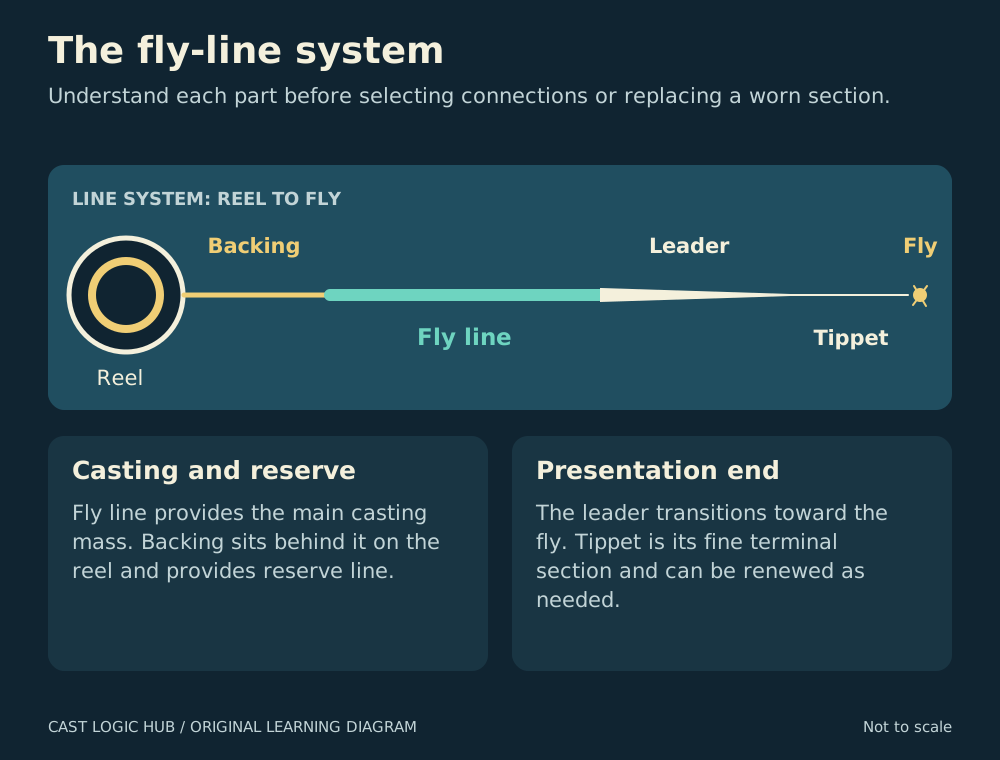
Understand the connected system
In a conventional fly outfit, backing connects to the reel and fly line; the leader connects the fly line to the terminal tippet and fly. The weighted fly line provides the mass used in the cast. Leader taper helps transfer that motion towards the fly, while the tippet is the fine terminal material. A poorly chosen terminal arrangement can undermine an otherwise suitable rod and line.
Keep a written record of the actual line model and density on each reel or spare spool. Several lines can look similar when wound up. The package code and product specification are more dependable than remembering that a particular spool was “the trout one.”
Read more than the line number
| Specification | Question it helps answer |
|---|---|
| Line weight | Is this within the rod maker’s intended pairing? |
| Taper and head design | Is the line designed for the delivery and line control needed? |
| Floating, intermediate or sinking design | How is the line intended to behave in the water? |
| Temperature and water application | Is the product intended for these conditions? |
| Published dimensions and mass | Am I comparing the same measurement between two products? |
Orvis recommends beginning with the rod’s intended line weight and testing suitable lines for the job. Its guidance distinguishes surface lines from sinking and specialist designs. Do not automatically increase line weight because a fly is difficult to cast; inspect the complete system and obtain an appropriate pairing recommendation.
Keep product facts separate from preferences
Scientific Anglers publishes line identification, taper information, intended conditions and mass specifications for its double-taper products. Those details establish what that product is. They do not prove every double taper is better than every weight-forward line, or that the same label creates identical behaviour across manufacturers.
When comparing two products, write down the exact model and version, specified head or belly length, mass reference and intended use. Keep grams and grains distinct when reading a specification table. Then record what you are trying to improve: short delivery, turnover, mending or reaching a particular depth. A purchase has a clearer purpose when it addresses a defined task.
Check the leader after repeated fly changes
Each retie consumes terminal material. Inspect whether the remaining tippet still suits the fly and whether the leader has been shortened into a thicker section. Replace damaged or depleted material with compatible tippet rather than allowing the outfit to change unnoticed during the day. A leader suitable for one presentation may need to be rebuilt when moving to a substantially different fly.
Choose knots and loop connections from the relevant line and leader instructions. Examine the junctions for damage and check them safely before fishing. Do not use a diameter label as a universal breaking-strength claim or assume an unknown old spool remains sound.
Run a useful comparison
- Choose a safe practice space, eye protection and a hookless yarn target.
- Use one rod and record the complete first line and leader system.
- Practise a realistic fishing distance rather than starting with maximum distance.
- Observe whether the delivery lands where intended and whether the terminal arrangement turns over consistently.
- Change one component only, using a pairing approved for the rod and intended task.
- Compare the same delivery, then write a specific result such as easier short-distance turnover rather than “more powerful.”
Carry the lesson to the water
A grass comparison cannot test drift, sinking behaviour or performance in a current. Confirm those separately in safe conditions, with the relevant technique. Keep casting competence, line choice and presentation decisions distinct. An experienced instructor can identify a casting fault before you spend money trying to solve it with another rod.
Questions from the bank
Keep it helpful. Comments are moderated. Do not share precise locations or personal information.
No approved comments yet. Ask a practical question or share what you learned.