

In this guide
Compare reels using published line recovery as well as gear ratio. Ratio describes a mechanical relationship; line recovery describes an amount of line retrieved per handle turn under the maker’s stated conditions. Neither number tells you the exact speed of a lure throughout a cast.
Read the two measurements separately
On a spinning reel, the ratio relates handle turns to rotor turns. A 6:1 label describes approximately six of those driven turns for one handle revolution. Line recovery is commonly printed as centimetres or inches per crank.
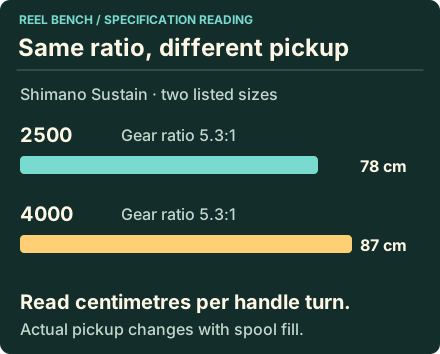
Spool dimensions matter. Shimano’s Sustain table separately lists ratio, spool diameter and line recovery. For example, its listed 2500 and 4000 models both have a 5.3 ratio, but their stated recoveries are 78 cm and 87 cm per crank. These are manufacturer specifications checked for that product table, not measurements made by this site.
| Figure | Useful for | Limit |
|---|---|---|
| Gear ratio | Understanding the gearing | Cannot alone compare recovery across spool sizes |
| Line recovery per crank | Comparing nominal pickup | Depends on the manufacturer’s test conditions and spool fill |
| Capacity | Matching line type and amount | Not an independent measure of retrieval speed |
| Maximum drag | A separate manufacturer limit | Not the correct fishing setting for every outfit |
Calculate a useful comparison
If a reel recovers 80 cm per handle turn and you make 30 turns per minute, the nominal recovery is 24 m per minute. The calculation is 0.80 m multiplied by 30. At 50 turns per minute it becomes 40 m per minute. These are arithmetic examples, not advised retrieve speeds.
The lure’s path still depends on rod movement, line bow, current and whether line is tight. A countdown of handle turns is useful for repeatability, but it does not establish a precise distance travelled by a lure that is rising, falling or moving sideways.
Match recovery to the presentation
Faster pickup can help recover slack after a rod movement or when a fish moves toward you. Daiwa’s gearing guidance also describes a trade-off between retrieval speed and comfortable winding under resistance. Avoid reducing that decision to “fast reels are advanced” or “slow reels are powerful”.
For a lure worked mainly with the rod, consider how efficiently you can recover surplus line between movements. For a lure pulled steadily through the water, consider comfortable cadence and resistance over a session. The right choice is the one that lets you control that method with the complete outfit.
Check recovery on your own reel
- Remove the lure and hook. Use a clear, unobstructed area where loose line cannot trip anyone.
- Mark a starting point on a measured length of line without cutting or damaging it.
- Retrieve a known number of complete handle turns with gentle, steady tension.
- Measure the line recovered and divide by the number of turns.
- Record the spool-fill condition and repeat to check consistency.
- Compare that result with the nominal specification, remembering that your setup and method may differ from the maker’s.
This is a simple home measurement, not a calibrated reel test. Its value is understanding your own outfit. Do not pull line under tension around bare fingers, and keep it away from people and animals while measuring.
Why recovery changes during use
A spool with less line has a smaller effective winding circumference. The same mechanism can therefore recover a different amount of line when much line is out than when the spool is fuller. This follows from the geometry of winding line, and is another reason not to infer exact lure speed from the label.
Do not overfill a reel to chase a higher recovery number. Follow the model’s loading guidance and keep line lay controlled. During a fight, stop cranking when the drag is giving line and no line is being gained; extra handle turns are not extra progress.
Make buying comparisons honest
Use exact model codes, a common unit for recovery and the same intended line. Keep price, weight, capacity and drag in separate columns. Choose for the fishing task rather than declaring a winner from one number. No comparative durability or field-performance claim follows from a specification sheet alone.
Questions from the bank
Keep it helpful. Comments are moderated. Do not share precise locations or personal information.
No approved comments yet. Ask a practical question or share what you learned.