
In this guide
A pond may be small enough to walk around, but that does not mean fish are spread evenly through it. Begin by observing the banks and surface from permitted ground. Look for practical places to fish, then choose among them using clues about cover, depth and food.
Confirm access and the fish present through the owner or managing authority. A pond beside a road is not automatically public water. Attractive photographs, old catch reports or a gap in a fence do not establish permission.
Separate observations from guesses
Visible reeds, overhanging vegetation, timber and shaded margins are cover. They may provide shelter or feeding opportunities, but each can also make casting and retrieval difficult. A darker patch might indicate deeper water, weed or simply a cloud’s shadow, so treat it as a clue rather than a measurement.
Watch for small fish, insects, birds feeding at the surface and repeated disturbances. None identifies the species with certainty. An isolated splash is not a reason to abandon a safe position and climb an unstable bank.
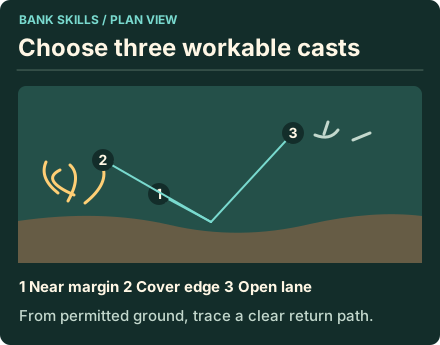
Choose three workable areas
Open full-size graphic · Missouri Department of Conservation
Pick a near-bank opening, an edge of vegetation and another accessible area with a different appearance. You do not need to reach the middle. Short presentations are easier to control and leave less line exposed to wind.
Before casting, imagine the entire route of the rig. Can it land without hitting a branch? Can you retrieve it without dragging through thick weed? Is there space to net a fish? A feature is only useful if you can fish it responsibly.
Start close and learn the depth
- Set up well back from the edge and keep unnecessary noise down.
- Try a short float presentation in clear water beside the chosen feature.
- Adjust the hook-to-float distance gradually, checking whether the bait or weight touches weed or bottom.
- Keep a note of the presentation that sits cleanly.
- Move to a second safe position if repeated checks show the first is unsuitable.
A float lying flat may indicate that the weight rests on the bottom, but it can also indicate a tangle or poor balance. Inspect the rig before deciding you have mapped the depth.
Use conditions without inventing rules
Shade, water temperature, wind and recent rainfall can change where fish feed. Their effects differ by species and pond. Avoid claims that every windy bank or every warm afternoon must be productive.
If the water is unusually low, very warm, discoloured by a suspected harmful bloom or showing distressed fish, pause and consult the managing authority. Do not keep fishing simply because fish have gathered in an obvious small area.
Leave a useful record
Record the general bank section, clarity, method and approximate fishing depth, including blank sessions. Over several visits, that tells you which observations were useful. Keep exact locations private if sharing them would pressure a small fishery or disturb vulnerable habitat.
Questions from the bank
Keep it helpful. Comments are moderated. Do not share precise locations or personal information.
No approved comments yet. Ask a practical question or share what you learned.