

In this guide
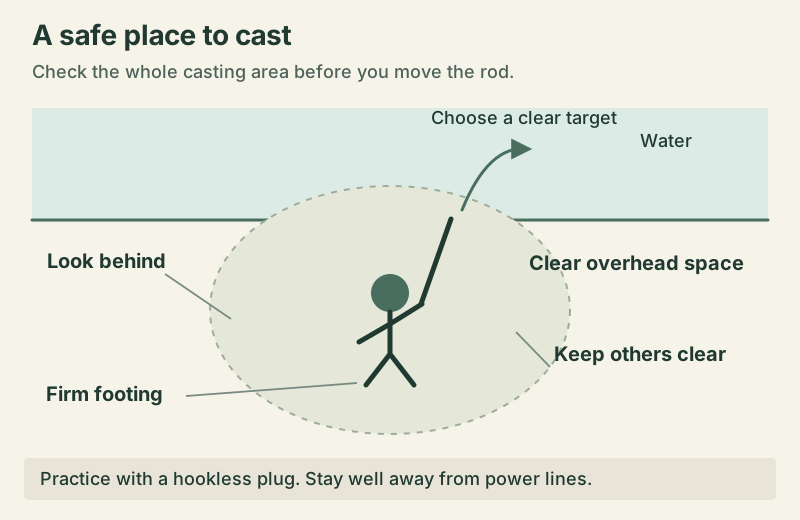
Your first casting target should be a safe patch of open ground or water within easy reach. Distance can wait. A short, controlled cast teaches the timing needed to release line without swinging a hook past another person.
Use a hookless casting plug or practice weight suited to the rod’s casting range. Practise only where it is permitted and there is room around and behind you. Keep clear of overhead electrical lines, paths, vehicles, trees and animals. Eye protection and closed footwear are sensible parts of the setup.
Understand what releases the line
On a spinning reel, opening the bail frees line to leave the spool. Your index finger holds the line against the rod until the release point. Leaving the bail closed can stop the cast abruptly; releasing the line before your rod movement starts can drop the weight at your feet.
Check the line path each time you set up. Line wrapped around the tip guide can prevent release and strain the rod. If anything feels wrong, lower the rod and inspect it instead of adding force.
A controlled practice cast
- Face the target with stable footing. Look behind and to both sides before every attempt.
- Position the practice plug a short, manageable distance below the tip, following the rod maker’s guidance.
- Hold the line with your index finger, then open the bail with the other hand.
- Make a smooth, compact casting motion. Release your finger as the rod moves toward the target.
- Allow the plug to travel, keeping the rod aimed along its path rather than sweeping across neighbouring space.
- Once it lands, close the bail by hand, check that line is on the roller and retrieve with light tension.
This is a practice outline, not a reason to force an overhead cast into an obstructed area. A qualified instructor can show a suitable alternative motion for restricted spaces. If the available room is inadequate, choose another spot.
Correct the common misses
A plug that goes sharply upward usually indicates an early release. A plug that hits close to your feet often indicates a late release. Reduce the effort, repeat the same small motion and change only the release timing so you can identify what improved.
If loops appear near the spool, stop before retrieving them tightly into the line. Check for slack line, overfilling or a bail that has not engaged properly. Do not pull a tight knot through the guides.
Add a fishing rig gradually
A float, weight and bait behave differently from a single practice plug. Shorten the first casts and keep the hook controlled while preparing. Never hold the rod in a casting position while someone is still baiting the hook.
Finish each practice session by securing the weight or removing the rig. Repeated accurate casts to a modest target are more useful than an occasional long cast that crosses someone else’s water.
Questions from the bank
Keep it helpful. Comments are moderated. Do not share precise locations or personal information.
No approved comments yet. Ask a practical question or share what you learned.