

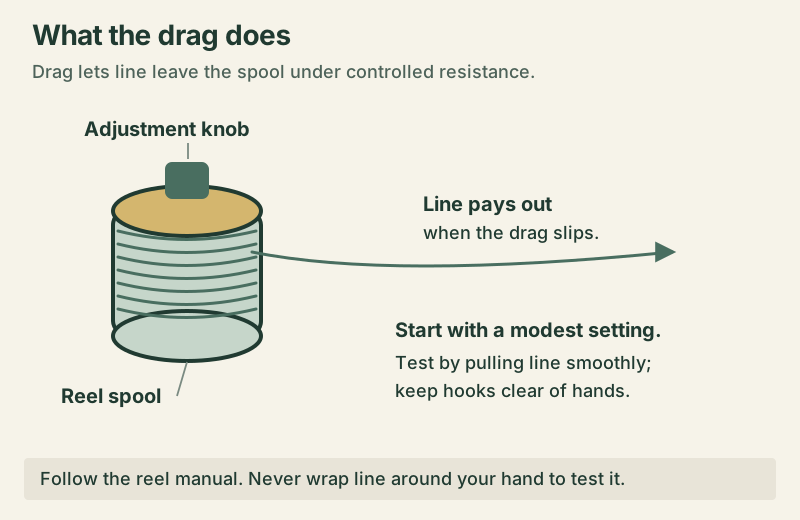
Drag is the reel’s adjustable resistance to line being pulled from the spool. It lets a fish take line while pressure remains on the tackle. Lock it too tightly and a sudden pull can break line or overload another part; leave it too loose and you may struggle to keep useful pressure.
The aim is a smooth, controlled release suitable for the complete outfit. The line’s printed breaking strength is not a promise about a wet knot, worn leader or damaged section. Set drag with those weak points in mind.
Prepare a safe check
Use the reel manual to identify its drag control. Many spinning reels use a knob at the front of the spool, but controls differ. Perform checks without an exposed hook, and keep line clear of people, animals and fragile objects.
A suitable spring scale can make a setting repeatable, provided it is attached safely and used within its range. A careful hand check can reveal a locked or jerky drag, but it does not provide an accurate measured force. Never wrap line around your fingers, especially braid.
Adjust in small steps
- Check that the line passes through every guide and is not wound around the rod tip.
- Begin with a relatively light setting and apply a steady pull in the normal working direction.
- Make a small adjustment, then pull again. Check the manual for which direction increases resistance.
- Look for line to leave the spool smoothly before the outfit is heavily strained.
- Repeat after changing spool, line, leader or other important components.
Do not test by hoisting a heavy object with the rod. That creates an uncontrolled load and encourages lifting at angles the rod was not designed to withstand. If you cannot judge a sensible starting setting, ask an experienced instructor to demonstrate with your equipment.
During a fish
Keep a controlled bend in the rod without lifting it vertically behind your head. Let the drag release line when required. If a spinning reel is giving line, avoid continuing to crank against it; wait until you can recover line under control.
Do not respond to a strong run by automatically tightening the drag. First check your stance and line path, and keep clear of obstacles. Fish near heavy snags may require a different outfit or position before you start, rather than a last-second adjustment beyond the tackle’s capacity.
Troubleshooting
A drag that sticks then releases suddenly needs investigation. Stop fishing and check the model’s maintenance guidance; adding an arbitrary lubricant to drag washers can cause further problems. A sound from the reel alone is not a reliable measurement of resistance.
If line breaks despite a light drag, inspect knots, guide rings, abrasion and the area above the rig. If the spool turns during every retrieve, the setting may be too light or the line may be slipping around the spool. Find the cause rather than tightening until something gives.
Questions from the bank
Keep it helpful. Comments are moderated. Do not share precise locations or personal information.
No approved comments yet. Ask a practical question or share what you learned.