
In this guide
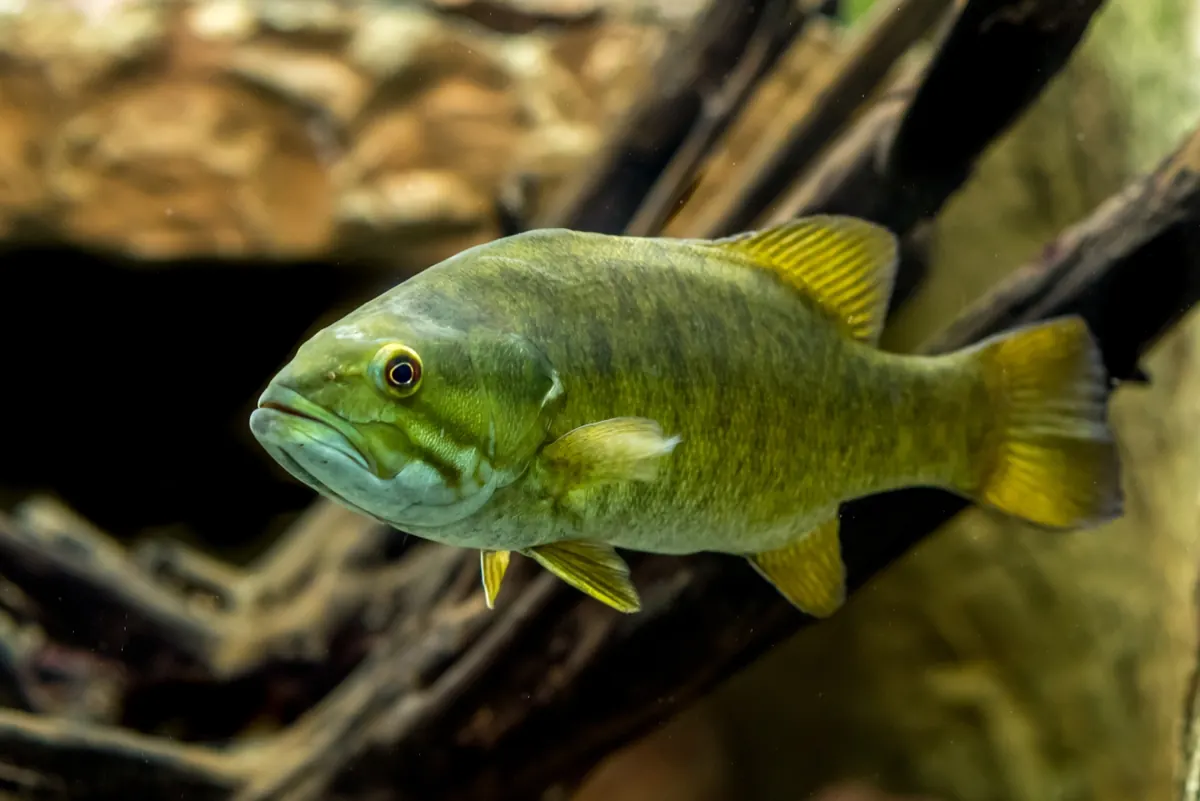
Smallmouth bass, Micropterus dolomieu, reward a deliberate look at rock, depth and current. A rocky bank is a starting clue, not a complete location plan. Learn the distinguishing features, then choose a presentation which reaches the useful part of the habitat without losing control.
Identify with several features
Typical fish have bronze or green-brown sides with vertical bars rather than the strong horizontal band associated with largemouth bass. The dorsal portions are connected, although the division can look pronounced. In adults, the upper jaw does not extend behind the back of the eye as it does in largemouth bass.
Agency drawings differ in the exact apparent jaw endpoint, and photographs change with mouth position and angle. Use the overall comparison, not a ruler drawn across a poor image. Spotted bass and local hybrids need further features from the regional guide. Red eyes, colour or a rocky capture location alone do not establish identity.
Link habitat to a presentation
North Dakota highlights rocky habitat, while Minnesota describes reefs, points, drop-offs, river riffles, eddies and pools. Missouri’s stream guidance places fish near suitable current breaks rather than simply in the strongest flow. Fish, crayfish and aquatic insects provide useful prey context.
On a lake, consider how a shallow rocky area connects to deeper water. On a river, observe where the flow slows or changes direction around the feature. Stay within safe access and boating limits; a fish-holding possibility does not justify entering an unsafe current.
Choose a clear first test
| Situation | Reasonable test | Question to record |
|---|---|---|
| Rocky point or shoreline | Controlled casting with an appropriate moving lure | Which part of the feature produces contact? |
| Deeper target or restricted area | A jig or soft plastic at a manageable weight | Can the presentation reach and remain in the intended area? |
| Fish responding near the surface | A suitable surface lure | Does a consistent retrieve or deliberate pause change the response? |
Agency fishing guides include these methods. The choices are comparisons to try, not claims that one method always belongs to one time of day.
Work a river feature deliberately
- Identify the feature, the main flow and a safe landing position before casting.
- Choose a lure whose weight and action suit the intended path.
- Make a controlled presentation past the target and watch how the current changes its movement.
- Repeat a useful lane before changing the lure. Then alter the angle or retrieve, keeping the other variables stable.
- Inspect after repeated bottom contact and replace damaged line or a damaged hook before continuing.
Missouri recommends working presentations with the current and notes that smallmouth commonly face upstream. Apply that as a reason to understand the drift, rather than assuming fish have one exact position behind every rock. If the lure crosses too quickly, a different casting angle may answer the problem before a tackle change does.
Separate results from assumptions
A follow, a short strike and a landed fish are different observations. Log them separately. If changing the retrieve and location at the same time produces a fish, you have a useful result but cannot isolate which change caused it.
Confirm current seasons and water-specific rules, especially around spawning periods. Avoid disturbing nests and do not tag or fin-clip fish as a personal tracking experiment. Record ordinary photographs and notes instead, with prompt, appropriate handling.
For the next trip, choose one feature type and two controlled presentations. The aim is to understand where each can be fished effectively, then carry that knowledge to another similar feature.
Questions from the bank
Keep it helpful. Comments are moderated. Do not share precise locations or personal information.
No approved comments yet. Ask a practical question or share what you learned.