
In this guide
Mending is repositioning fly line after it reaches the water. Use it for a purpose: keeping a dry fly or nymph drifting appropriately, or deliberately controlling a wet-fly or streamer swing. An automatic upstream flick after every cast can create as many problems as it solves. First decide what the fly should do and which part of the line is interfering.
Find the competing current lanes
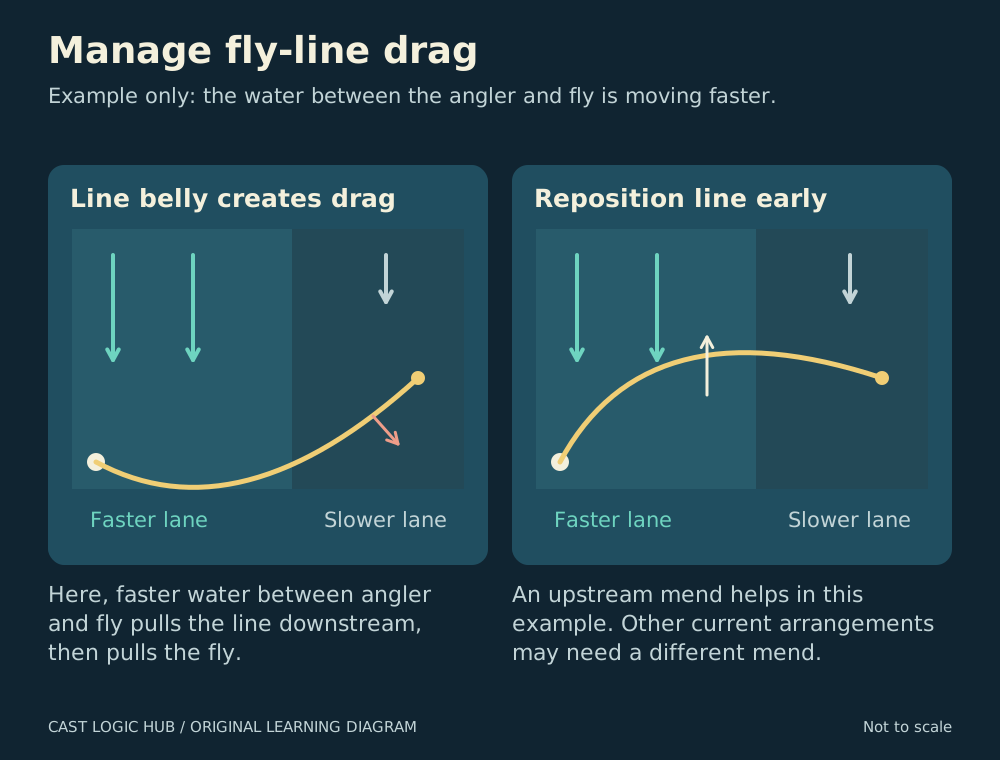
Look at the water carrying the fly and the water carrying the line between you and the fly. If the near line is swept downstream faster than the fly’s lane, a downstream belly can pull the fly. An upstream mend may delay that pull. Where the near line lags behind a faster fly lane, a downstream adjustment may be appropriate. The relative movement tells you the direction, not a fixed rule based on which bank you stand on.
Orvis describes drag as line or leader tension making the fly move contrary to the intended natural drift. In a deliberate streamer swing, tension and movement can be part of the presentation. Do not diagnose every moving fly as an error without considering the method.
Lift before repositioning
The basic Orvis mending lesson separates lifting line from redirecting it. Break the surface contact of the part you want to move, place it where needed and allow the drift to continue. Dragging the whole length sideways across the surface can pull the terminal arrangement with it. Practise with a hookless indicator or yarn reference in a safe place before targeting a fish.
Make the first correction early enough that a large belly has not already developed. You may need another small correction later, but constant disturbance is not the goal. If every mend moves the fly, reconsider the cast length, angle and where you are standing rather than repeating the same large movement.
Use a clear drift test
- Choose a short safe presentation crossing as few different current lanes as practical.
- Identify the intended fly path and watch nearby bubbles or debris as a surface reference.
- Make a cast and observe which portion of line begins to pull.
- Lift and reposition that portion in the necessary direction.
- Watch whether the dry fly or indicator jumps. If it does, use less line movement or alter the next cast.
- End the drift deliberately and repeat with one change. Compare the length of controlled drift, not only whether a fish took.
Match the correction to the problem
| Problem | First check | Adjustment to practise |
|---|---|---|
| Near line races ahead of the fly | A faster current under the line. | An upstream reposition of the affected line. |
| Fly lane advances while near line holds back | A slower current close to the angler. | A downstream reposition when it reduces the pull. |
| Fly skates during every correction | The mend is moving the leader or fly. | Lift and move less line; shorten the cast. |
| No manageable drift spans the intended area | Too many conflicting currents. | Change the presentation angle from a safe position. |
Nymphs need attention below the indicator
When indicator fishing, Orvis recommends moving the line without displacing the indicator. Moving it can also move the submerged flies. A well-behaved indicator is useful evidence about the presentation but is not a camera beneath the surface. Depth, leader angle and bottom contact still require assessment.
Use the nymph-depth tutorial to separate those questions. Do not keep adding weight solely because a poor line position prevents the rig from settling. Likewise, a perfect surface mend cannot correct a rig that is badly matched to the depth.
Practise the smallest useful correction
Set a personal exercise: make several short drifts and note where each first loses control. Try a changed casting angle before a larger mend. If a safe change in position places more line in the same current as the fly, test that too. Never step into uncertain water to obtain a theoretically better line angle.
Stop when the intended drift is over. Dragging an exhausted presentation through several extra lanes provides little information and may disturb fish you plan to approach next. Retrieve, choose the next lane and make a fresh delivery with a clear purpose.
Questions from the bank
Keep it helpful. Comments are moderated. Do not share precise locations or personal information.
No approved comments yet. Ask a practical question or share what you learned.