

In this guide
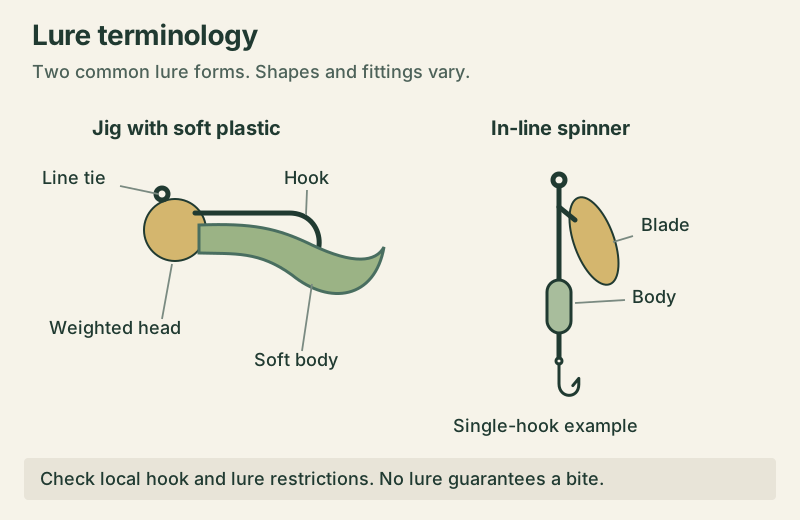
A lure is an artificial offering that you move through the water to suggest food or provoke interest. The retrieve is the way you wind line and move the rod after casting. For a beginner, a repeatable retrieve is more useful than a box full of shapes you have not learned to control.
Choose a lure suited to fish confirmed at the water and within the rod’s casting-weight range. Check restrictions on lure type, hook points, barbs and target species. Artificial lures are not automatically permitted everywhere that fishing is allowed.
Begin with an observable lure
A small inline spinner or a simple jig with an appropriate soft-plastic body gives you a clear job to learn. A spinner relies on its blade turning; a jig changes depth as you allow it to sink or lift it. They are examples, not universal winners.
In clear, safe shallows, watch how the lure behaves beside the bank before making a full cast. Find a retrieve that makes it work without rolling unnaturally or dragging constantly through weed. Keep the hook away from feet, hands and other anglers.
Establish a baseline
- Check the knot, hook condition and drag.
- Make a short cast into open water with a clear return route.
- Start with a steady retrieve that keeps the lure away from obvious obstacles.
- Observe what you can: blade movement, vibration, weed on the hook or contact with the bottom.
- Repeat several controlled casts before changing a single variable.
A sinking lure can be allowed a little more time before retrieval to explore deeper water. The count is a repeatable observation for that lure and situation, not a calibrated depth measurement. Current, line diameter and lure shape alter the descent.
Change speed and angle thoughtfully
If the lure catches weed on every cast, begin retrieving sooner, choose a shallower route or change the presentation. If you retrieve directly over a branch, a different angle may offer a clear path beside it. Do not cast deeper into an obstacle simply because it looks promising.
A pause can change a sinking lure’s depth, so use it where there is room below. Some lures work poorly at extremely slow speeds. Watch the lure rather than assuming slower always means better.
When something follows or strikes
A following fish tells you it noticed the lure; it does not prove a particular colour change will catch it. Continue a controlled retrieve and stay ready. Avoid jerking the lure toward yourself when it reaches the bank.
When a fish connects, maintain steady pressure and use the rod and drag together. Keep a landing net and unhooking tools ready, particularly when the lure carries more than one point. Never grab an active lure beside a struggling fish.
Record the lure, depth approach and retrieve that you used. On the next trip, start with that clear method and test changes deliberately. Good observation travels better than a promise that one lure catches everything.
Questions from the bank
Keep it helpful. Comments are moderated. Do not share precise locations or personal information.
No approved comments yet. Ask a practical question or share what you learned.