

In this guide
Start a battery plan with the electrical equipment, not the largest capacity number in an advertisement. The system must supply the right voltage, support the required current, fit the boat and work with its charger. Runtime comes after those compatibility checks.
Collect the exact specifications
Record model numbers for the motor, electronics, battery and charger. Copy their electrical requirements from current manuals, not a discussion about a similar version. Minn Kota’s guidance makes clear that power requirements and lithium compatibility depend on the motor family. A battery chemistry accepted by one installation is not automatic approval for another.
| Item | Information to obtain |
|---|---|
| Motor | Required system voltage, maximum current and approved battery guidance. |
| Electronics | Input-voltage range and stated power or current demand. |
| Battery | Nominal voltage, capacity, continuous current limit, usable-discharge and temperature guidance. |
| Charger | Approved chemistry, voltage, battery configuration and charging conditions. |
| Installation | Space, secure mounting, ventilation where required, cable run and protection specified for the system. |
Understand the units
Amp-hours describe charge capacity at a specified test rate; volts describe electrical potential. For a first energy comparison, nominal watt-hours equal nominal volts multiplied by amp-hours. Two packs with the same amp-hour figure but different voltages do not contain the same nominal energy.
That arithmetic does not specify how much energy the installed system can safely use. Battery age, temperature, discharge rate, the maker’s operating limits and conversion losses can affect the result. Keep the manufacturer’s conditions beside each figure rather than stripping them off to produce a simple ranking.
Make an estimate with stated assumptions
- List the devices that may run together and separate essential loads from optional fishing equipment.
- Use documented or measured demand for the intended operating condition. If only a maximum motor current is published, label it as maximum, not average use.
- Estimate the time each load will operate. Do not silently assume every device draws its maximum continuously.
- Calculate energy by multiplying watts by hours, or estimate hours from usable amp-hours divided by average amps when voltage and other assumptions are consistent.
- Reserve capacity for the return and for unexpected conditions. Choose that reserve through the actual boating plan and competent installation advice rather than a universal percentage.
- Validate the plan during a controlled, short outing with an independent means of returning safely.
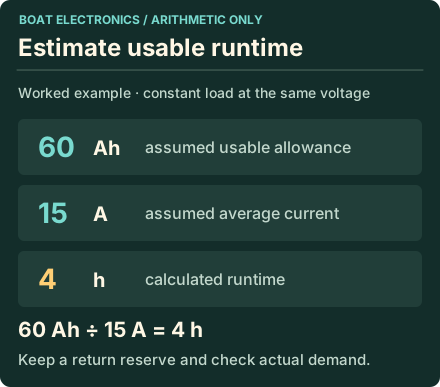
For arithmetic only, a hypothetical usable allowance of 60 Ah divided by a steady 15 A load gives four hours. That is not a product rating or a promised trip duration. If the current changes, the assumption behind the answer changes too.
Check current delivery as well as capacity
A high-capacity battery can still be unsuitable if it cannot supply the load’s required continuous current. Minn Kota identifies inadequate lithium current delivery as a possible cause of shutdown and operating problems. Ask the battery and motor suppliers to confirm the combination, including any battery-management-system limits.
Physical group size is another separate specification. Minn Kota’s battery guide explains that it describes dimensions, not a complete capacity or compatibility guarantee. Measure the installation space and include battery mass in the boat’s loading assessment.
Give a technician a complete brief
Use a qualified marine technician for wiring changes. Minn Kota’s installation guide calls for appropriate circuit protection and conductor sizing and notes that extra devices, longer runs and installation conditions can change the requirements. Copying a cable size from another boat omits those conditions.
Bring the load list, manuals, cable-route information and proposed battery locations to the installer. Ask how essential circuits will remain available, how the battery is isolated and secured, how charging is controlled and what inspection procedure the owner should follow. This guide intentionally provides no improvised series-wiring or fuse-selection recipe.
Keep a usable operating record
After each early outing, record starting charge indication, operating duration, conditions, motor usage and any warnings. An unexplained shutdown, hot connection, damaged case or recurring fault is a reason to stop using the affected equipment and obtain the relevant service advice, not to increase a protection rating.
Use the battery maker’s maintenance and storage instructions for its exact chemistry. Revise the plan when you add electronics or when performance changes. A dated load worksheet is far more useful than remembering that the boat once managed a long day.
Questions from the bank
Keep it helpful. Comments are moderated. Do not share precise locations or personal information.
No approved comments yet. Ask a practical question or share what you learned.