

In this guide
Indicator nymphing works best when you distinguish four questions: how deep the water is, how long the flies have to sink, how the rig is moving and whether you can detect an interruption. Changing the fly pattern first can leave the real problem untouched. Start with a manageable current lane and adjust the presentation before building a more complicated rig.
Leader distance is not vertical depth
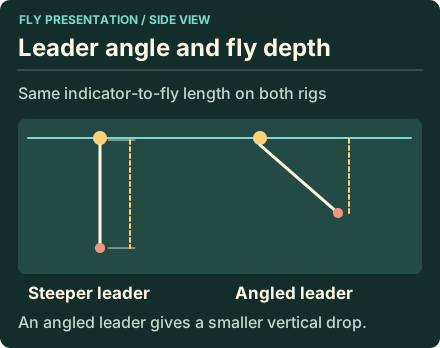
The distance from indicator to fly is measured along the leader. In moving water, the leader often hangs at an angle, so that distance does not equal the fly’s vertical depth. Orvis gives indicator spacing relative to estimated depth as an initial guide, then stresses adjustment. Treat any starting ratio as a trial setting rather than a measurement of the river bottom.
Estimate the area from safe observation and suitable local information. Do not wade into unknown depth to measure a fishing position. Keep a note of the initial indicator spacing and rig so an adjustment can be reversed if it performs worse.
Allow time to reach the target lane
A nymph begins sinking after it lands. If the target is immediately below the entry point, the fly may pass it before reaching the intended depth. Orvis’ drift instruction explains this settling phase and how surface or cross-lane current can pull the rig out of its intended path. Review the entry point and line position before assuming the fly requires more weight.
Start in a relatively uniform lane where the drift is easier to interpret. Broken but consistent flow can provide a clearer practice environment than several rotating currents. Choose the water because you can present and observe the rig there safely, not because a lesson promises that all fish occupy one type of current.
Adjust one variable at a time
| Observation | Possible explanation | Controlled test |
|---|---|---|
| Rig passes the target before settling | Insufficient sinking time or unsuitable weight. | Alter entry point first, then reassess weight if needed. |
| Repeated hard bottom contact | Too much depth or weight for this lane. | Reduce one setting and inspect the rig. |
| Indicator accelerates across the lane | Line or indicator pulling the flies. | Improve line position and casting angle. |
| Indicator disappears without a clear pull | It may be a take, bottom contact or inadequate support. | Make a controlled response, then assess the pattern. |
Run a deliberate drift
- Check local restrictions on hooks, added weight and indicators before assembling the rig.
- Use the simplest arrangement that lets you investigate the lane, with connections inspected and tested.
- Choose an entry point that gives the fly time to settle before the target.
- Follow the indicator and manage excess line without pulling the rig across the current.
- Respond promptly to an unexplained pause, dip or sideways movement with a controlled hook-setting movement.
- Retrieve after the useful drift, inspect for fouling and repeat. Change one setting only when the observation gives you a reason.
Read the indicator without overclaiming
Orvis describes takes that range from a clear plunge to a small hesitation, with subtle signals especially relevant in slower water. Select an indicator you can see and that supports the rig appropriately. A larger device is easier to track in some conditions, while a more sensitive arrangement may reveal movements that another indicator conceals.
Compare its travel with nearby surface debris, but do not call that proof of an entirely drag-free submerged fly. Surface and deeper water can move differently. If a suspicious movement repeats at exactly the same place, consider bottom contact as one explanation while continuing to respond carefully.
Keep a short adjustment record
Write down the lane, initial spacing, added weight if any, entry point and what changed. Include failed settings. “Longer spacing caused repeated bottom contact” gives the next visit a useful starting point; “the fish wanted a heavier nymph” states a conclusion the observation may not support.
If the rig tangles repeatedly or becomes difficult to cast, simplify it and return to controlled practice. A second fly adds another hook and another potential tangle. More components do not improve a presentation you cannot deliver, track and retrieve reliably.
Questions from the bank
Keep it helpful. Comments are moderated. Do not share precise locations or personal information.
No approved comments yet. Ask a practical question or share what you learned.